Room AC size calculator: how many BTU do I need?
Enter the room size and a few details, and see the BTU rating to look for in a window or portable air conditioner. It uses the Energy Star sizing chart and its adjustments.
- Energy Star chart
- Sun, people and kitchen
- Too big is flagged
Sizing chart and adjustments from Energy Star. It's a guide for room units; central air needs a load calculation by a pro. Source: Energy Star: Room Air Conditioners.
Do the job
How it works
Room area = length × width. The Energy Star chart gives a capacity for each size range, starting at 5,000 BTU for 100 to 150 sq ft.
Sun: heavily shaded rooms get 10% less; very sunny rooms get 10% more.
People: add 600 BTU for each person beyond two who is regularly in the room.
Kitchen: add 4,000 BTU.
About this tool
Who it's for
For anyone buying a window or portable air conditioner for one room.
Example
You enterA 15 x 12 ft bedroom, average sun, 2 people
You get180 sq ft, so about 6,000 BTU.
What's different
- Uses the published Energy Star chart, not a guess per square foot.
- Adds the sun, people and kitchen adjustments.
- Explains why a bigger unit isn't better.
Gotchas and tips
- Measure only the space the unit really has to cool; doors you keep closed split the room.
- Portable units are often rated differently; check the label's SACC rating.
- A clean filter matters as much as the size.
Privacy: Runs entirely in your browser. Nothing you type is sent to us.
Built and maintained by the GrabTheHammer team. Updated November 2026. Spot a problem? Tell us.
The Energy Star sizing chart
This is the chart the calculator uses, before the sun, people and kitchen adjustments.
| Room area (sq ft) | Capacity (BTU per hour) |
|---|---|
| 100 to 150 | 5,000 |
| 150 to 250 | 6,000 |
| 250 to 300 | 7,000 |
| 300 to 350 | 8,000 |
| 350 to 400 | 9,000 |
| 400 to 450 | 10,000 |
| 450 to 550 | 12,000 |
| 550 to 700 | 14,000 |
| 700 to 1,000 | 18,000 |
| 1,000 to 1,200 | 21,000 |
| 1,200 to 1,400 | 23,000 |
| 1,400 to 1,500 | 24,000 |
| 1,500 to 2,000 | 30,000 |
| 2,000 to 2,500 | 34,000 |
Getting the most from a room unit
- Seal the side panels and window gaps with foam so hot air can't leak in.
- Close curtains on the sunny side during the afternoon.
- Clean the filter every couple of weeks during heavy use.
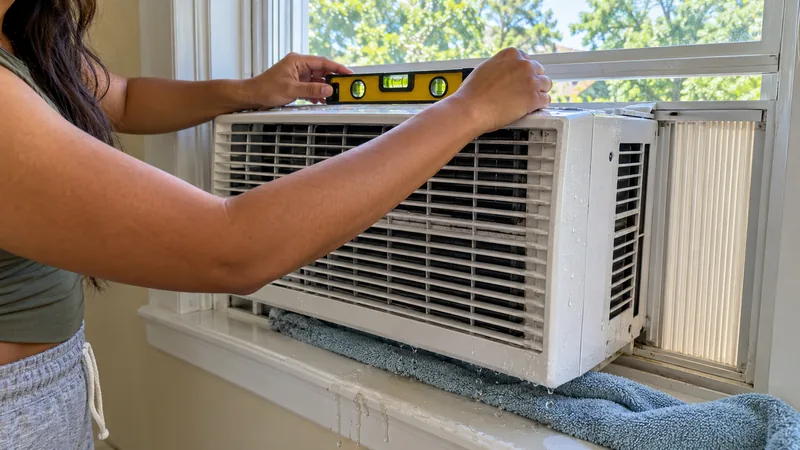
- Tilt a window unit very slightly to the outside so water drains out, not in.
Room AC sizing questions
Is a bigger air conditioner better?
No. An oversized unit cools the room quickly and then shuts off before it has removed much moisture, so the room feels cold and clammy. Match the size to the room.
Does this work for central air?
No. Whole-house systems are sized with a load calculation (Manual J) that looks at insulation, windows, ductwork and your climate. Ask a heating and cooling pro for one.
What does BTU mean?
British thermal unit. For air conditioners it's a measure of how much heat the unit can remove from the room in an hour.
Does ceiling height matter?
The chart assumes ordinary 8 foot ceilings. For tall or vaulted ceilings there is more air to cool, so lean toward the next size up.
Should two connected rooms share one unit?
Only if the air can move freely between them. If there's a door or a narrow hall, size for the room the unit is in, or use one unit per room.
Can I use a window AC in a room with a slider or casement window?
Standard window units need a single- or double-hung window. For sliders and casements, look for units made for them, or a portable unit with a window kit.