Heating & cooling

AC not cooling? Check these first

AC running but the air isn't cold? Start with what you can check yourself: the thermostat settings, the air filter, the breakers and the outdoor unit. A clogged filter or a dirty outdoor coil can make a working system seem broken. If those all check out, it's time for a technician. It's worth ten minutes of checking before you book a visit, since a lot of summer service calls end with a technician swapping a filter or flipping a breaker.

Gloved hands clearing weeds and debris from around an outdoor AC unit with dirty fins, a garden hose on the lawn
A clogged outdoor unit can't shed heat, so check it before calling for service.
Quick answerCheck the thermostat is on COOL with the fan on AUTO, replace the filter, check the breakers and outdoor switch, and clear the outdoor unit. Ice on the lines means turn it off and call a tech.
Worth checking firstCheck the thermostat is on Cool and set below room temperature, then go outside and see whether the big fan on the outdoor unit is spinning. If the indoor fan runs but the outdoor unit is silent, check the outdoor disconnect switch and the breaker before calling.

Good to knowRepair or replace?Filter scheduleNo toolbox needed

Easy20–45 min$0–30
Central AC system showing thermostat, indoor air filter, outdoor condenser fan, dirty fins and disconnect box
AC not cooling? Check the thermostat setting (1) and air filter (2) inside, then the outdoor unit: the fan (3), dirty fins (4) and the disconnect switch (5).

How central air works

Central air works by pulling heat out of your house and dumping it outside. The indoor part cools the air, and the outdoor unit, called the condenser, releases the heat through a big grid of metal fins while a fan blows across them. If air can't move through the filter inside, or through the fins outside, the whole system struggles. That's why the first fixes are all about airflow.

One warning sign to know: if you see ice on the copper lines or the indoor unit, turn the cooling off and let it thaw. Running a frozen system can damage the compressor, the most expensive part.

Why it isn't cooling

A clogged

The first thing to check. Without enough airflow, the indoor coil can even freeze over.

A thermostat setting

Fan set to ON instead of AUTO blows room-temperature air between cooling cycles, which feels like the AC isn't working.

Dirty outdoor coils

Dust, grass clippings and cottonwood fluff block the fins, so the unit can't get rid of heat.

A failed part or low refrigerant

A bad capacitor, a stopped fan, or a refrigerant leak needs a licensed technician.

Read the symptoms
What you noticeMost likelyTry this
Nothing runs at allThermostat or powerCheck the thermostat, breakers and outdoor disconnect.
Indoor fan runs, outdoor unit silentOutdoor power or a failed partCheck and breaker. If they're on, call.
Both run, air isn't coldDirty filter or coilsReplace the filter, clean the outdoor unit.
Ice on the copper linesAirflow or refrigerantTurn it off to thaw, change the filter, then call if it returns.
Water around the indoor unitClogged Shut it off and clear the drain line.
Power off outsideTurn off power at the outdoor disconnect before touching or cleaning the outdoor unit.

Run through the checks

0 of 5 done
  1. Check the thermostatSet it to COOL, fan on AUTO, and a temperature at least 3 degrees below the room. Replace the batteries if the screen is dim or blank.
    Thermostat display set to COOL at 72 degrees with the fan on AUTO
  2. Replace the air filterA clogged filter starves the system of air and can freeze the indoor coil. If yours is gray, swap it now.
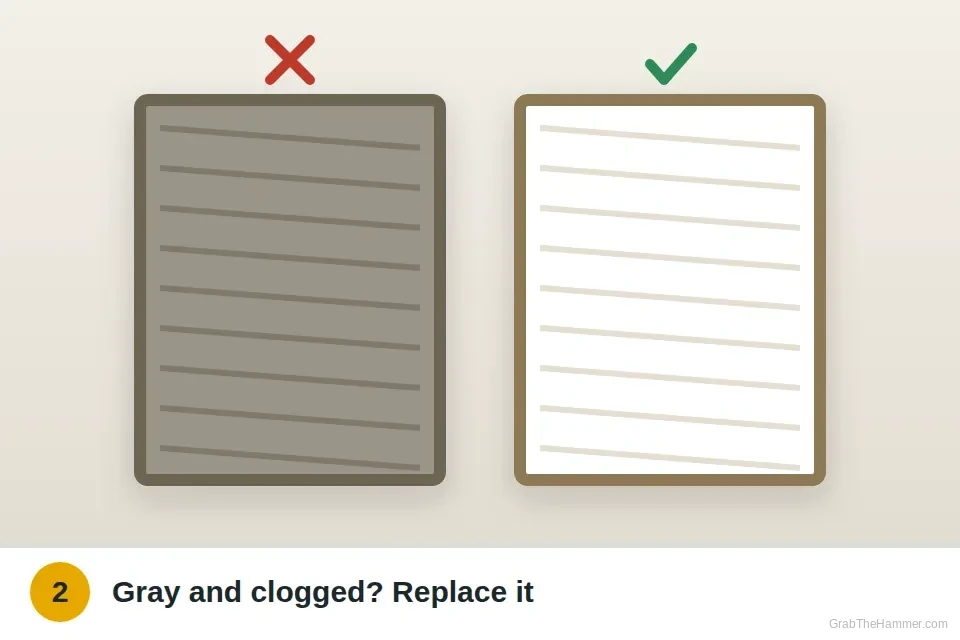
    Clogged gray air filter pulled out next to a clean white replacement
  3. Check the breakers and the outdoor switchLook for a tripped breaker labeled AC or condenser, and make sure the disconnect box on the wall by the outdoor unit is on.
    Something went wrong?
    • You can't find the disconnect It's usually a small gray box on the wall near the outdoor unit. Some have a pull-out block that has to be pushed in the right way.
    • The breaker trips again Leave it off and call a technician. Repeated trips can mean a failing compressor or fan motor.
    Breaker panel with the AC breaker tripped and the outdoor disconnect switch pulled out
  4. Clean the outdoor unitTurn the power off at the disconnect. Clear leaves and weeds 2 feet back, then gently hose the fins from the outside in. Never use a pressure washer, which flattens the fins.
    Something went wrong?
    • The fins are bent Straighten them gently with a fin comb. Don't use a screwdriver; it tears them.
    Outdoor AC condenser with leaves cleared away and a garden hose gently rinsing the fins
  5. Give it time and check the airTurn the power back on, wait 5 minutes, and run it for 30 minutes. Air from the vents should feel about 15 to 20 degrees cooler than room air.
    Something went wrong?
    • The outdoor fan isn't spinning Turn the power off. A fan that doesn't start often has a failed capacitor, which is a job for a technician.
    • There's ice on the lines Turn the cooling off and run the fan until it thaws. Change the filter before trying again.
    Hand near a ceiling supply vent feeling cool air after the AC runs for 30 minutes

Watch it done

Central Air Troubleshooting - Top 10 AC ProblemsBy Word of Advice TV on YouTube. Their method may vary a little from ours.
Watch on YouTube
How you'll know it's fixed
  • The thermostat is on COOL and the system starts
  • The outdoor unit runs with its fan spinning
  • After 30 minutes, vent air feels about 15 to 20 degrees cooler than the room

Outdoor unit hums but fan won't spin? Turn it off and call a technician.

If the house is still warm

If the outdoor unit hums but its fan isn't spinning, turn the power off right away. That's usually a failed capacitor, a quick repair for a technician, but running it that way can damage the compressor.

If the indoor unit runs but the outdoor unit is silent, check the outdoor disconnect and breaker again, and look at the thermostat wiring for anything chewed or loose.

On really hot daysOn really hot days, even a healthy AC may only keep the house about 20 degrees below the outside temperature. Closing blinds on sunny windows helps it keep up.
Renting?If you rent, you can check the thermostat, breakers and filter. Repairs to the unit itself are the landlord's job.
Call an HVAC tech ifIce on the lines, a humming or clicking outdoor unit with the fan not spinning, hissing sounds, or warm air after all these checks. Low refrigerant and failed capacitors need a licensed HVAC technician.Fix it yourself or call? Compare the cost →

What a pro typically charges (a rough estimate; prices vary by area): A typical AC service call runs $100–$300. A capacitor replacement usually costs $150–$400; refrigerant leak repairs can run $300–$1,500.

Find an HVAC technician near you

Other heating and cooling problems

AC questions

Why is my AC running but not cooling?

Common causes include a dirty filter, a thermostat set to fan-only, a tripped breaker on the outdoor unit, or dirty condenser fins. Check those before calling for service.

Why is there ice on my AC lines?

Usually restricted airflow from a dirty filter, or low refrigerant. Turn cooling off, run the fan to thaw it, replace the filter, and call a technician if it refreezes.

How cold should the air from my vents be?

About 15 to 20 degrees cooler than the air in the room.

How long should my AC run to cool the house?

On a hot day, it's normal for it to run long cycles. Most systems can only hold the house about 20 degrees below the outdoor temperature, so on a 100-degree afternoon, a 72-degree setting may be out of reach.

Is it okay to keep running the AC while it's not cooling?

If there's ice on the lines or the outdoor fan isn't spinning, turn it off. Otherwise it's fine to run while you check the filter and the outdoor unit.

Reader reports

Did this fix work for you?

Tell the next person how it went. Your numbers are added to the totals anonymously; tips are read by our team before they appear.

How did it go?
Reader Q&A

Questions from readers

No questions on this guide yet. If you're stuck, ask below. Useful questions and answers get added here for the next person.

Ask a question

We read every question before anything is published, and we never show names or emails. Please leave out personal details. PrivacyAccessibility

About the authors

GrabTheHammer Team

  • No sponsored picks
  • Safety first
  • Tells you when to call a pro

We're a small team of writers and editors who check every guide against manufacturer instructions and common code requirements. Our goal is to help you understand the problem, tackle what you safely can and know when to call a pro.

Checked against: Manufacturer instructions for the parts and products involved, ENERGY STAR, U.S. Department of Energy.

How we write and review →
A helpful next stepClean your AC condenser coilsBrush, foam and rinse the outdoor unit's fins so it can shed heat.