Remove a stripped screw
To remove a stripped screw, stop turning as soon as the bit slips, then work through the fixes from easiest to hardest: the right bit with firm pressure, a rubber band for grip, a slightly bigger bit tapped in, and a screw extractor. If the head sticks up, locking pliers will often turn it. Drilling the head off is the last resort, and it almost always works. Start gentle, and save the drill for last.


Why screw heads strip
A screw head strips when the bit spins inside it and rounds off the slots. It usually happens because the bit is the wrong size or type, the driver wasn't held straight, there wasn't enough pressure, or the screw is rusted or painted in place.
Every extra turn with a slipping bit makes it worse, so the first rule is to stop. Most stripped screws come out with grip and pressure. A screw extractor is a hardened bit with reverse threads that bites into the screw as you turn it counterclockwise; it's the tool for screws that are truly rounded out.
What causes a stripped screw
It spins inside the head.
The bit rides up and out.
The screw is stuck in place.
Rounded tips slip.
| The head is | Try | Start at |
|---|---|---|
| Slipping but not rounded | Right bit, more pressure | Step 1 |
| Partly rounded | Rubber band or bigger bit | Step 3 |
| Fully rounded out | Screw extractor | Step 5 |
| Sticking up | Locking pliers | Step 6 |
| Extractor snapped | Call a pro | Call a pro |
Let's fix it
- Stop and pick the right bitAs soon as the bit slips, stop. Check the screw head and try the bit that fills it best; many screws people think are Phillips are actually a different size or a square drive. For a rusty or painted screw, scrape the paint out of the slots and put a drop of penetrating oil on it, then wait a few minutes.

- Push hard and turn slowlyHold the driver straight in line with the screw, lean your weight onto it, and turn slowly counterclockwise. With a drill, use the lowest speed and the clutch on a low setting. Pressure keeps the bit from riding up and out of the head.

- Add a rubber bandLay a wide rubber band flat over the screw head and press the bit through it into the head. The rubber fills the stripped gaps and adds grip. Turn slowly with firm pressure.

- Tap in a bigger bitTry a bit one size larger, or a Torx bit that just fits, and tap it into the head with a hammer so it bites into the soft metal. Then turn it out slowly with steady pressure.

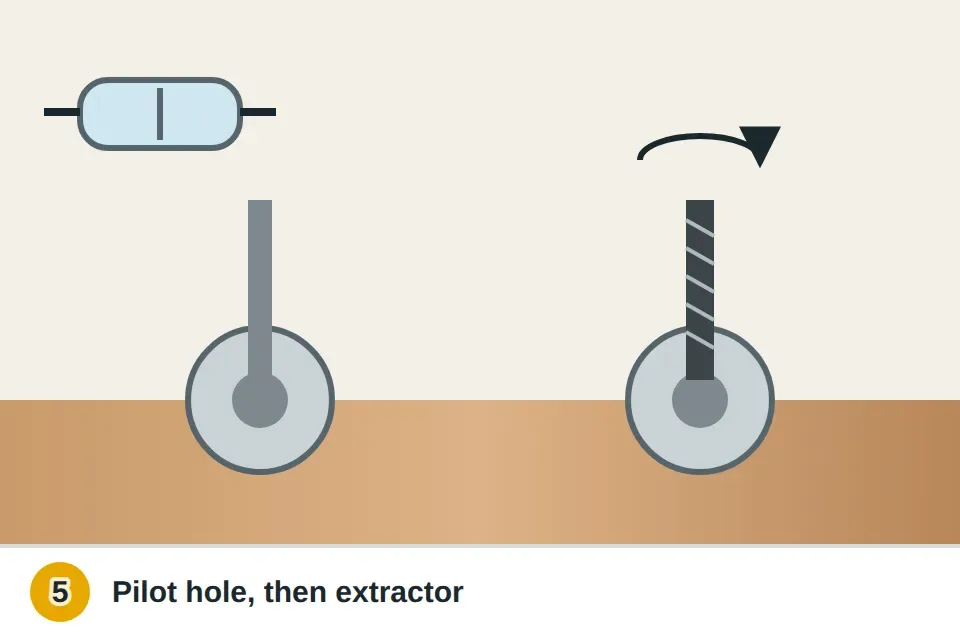
- Use a screw extractorPut on safety glasses. Drill a small pilot hole in the center of the screw head with the drilling end of the extractor set, or the bit size the set calls for. Most sets use a left-hand bit that cuts with the drill in reverse; a standard bit cuts with the drill forward. Then put the extractor in the drill in reverse, press firmly and let it bite and back the screw out at low speed. Don't force it; extractors are hard and brittle and can snap.
- Grab the head or drill it offIf the head sticks up even a little, clamp locking pliers tight on it and turn. If nothing else works, drill straight down into the head with a bit about the size of the screw's shank, starting smaller and stepping up and keeping it centered, until the head pops off. Lift off what it was holding, then turn the remaining shank out with locking pliers.

Watch it done
- The screw is out
- The surface around it is intact
- The hole is ready for a new screw
If the hole is stripped instead
If the screw spins in place and won't tighten, the hole is stripped; see the guide for stripped door hinge screws.
If it's a nail rather than a screw, see the guide for pulling a stuck nail.
What a pro typically charges (a rough estimate; prices vary by area): A handyman typically charges $75–$150 for a visit to remove stubborn or broken screws, more if a snapped extractor has to be drilled out.
Find a carpenter near youSomething else going on?
Stripped screw questions
How do you remove a stripped screw?
Stop turning, then try the right bit with heavy pressure, a rubber band, a slightly bigger bit tapped in, a screw extractor, or locking pliers on the head.
Does the rubber band trick work on stripped screws?
Often, on screws that are only partly stripped. Lay a wide band over the head and press the bit through it.
How does a screw extractor work?
You drill a small pilot hole in the head, then the extractor's reverse threads bite in and back the screw out as you turn it counterclockwise.
What if a screw extractor breaks?
Stop. Extractors are hardened and very hard to drill out. That's a job for a handyman or machinist.
How do I keep screws from stripping?
Use a fresh bit that fits the head snugly, keep the driver straight, and push hard while turning slowly.