Noisy garage door
A noisy garage door usually just needs tightening and lubricating. Squeaks come from dry hinges, rollers and springs, rattles from loose bolts, and grinding from worn rollers or a dry opener chain. Most of this is safe DIY work. The springs, the cables and the bottom brackets are under very high tension, though, so leave those to a garage door pro. Most garage door noise goes away with a wrench and the right lubricant.


Why garage doors get noisy
A sectional garage door has panels joined by hinges, with a roller on each hinge riding in a metal track on each side. A torsion spring above the door, or extension springs along the tracks, carries most of the door's weight, and steel cables run from the springs to brackets at the bottom corners. The opener only pushes and pulls; the springs do the lifting.
Every time the door moves, hundreds of pounds of metal flex and roll, so bolts loosen and pivots dry out. Steel rollers with exposed bearings get loud as the bearings wear, and an opener chain that's dry or sagging slaps and clatters. Belt-drive openers are naturally quieter than chain-drive ones, which matters if a bedroom is over the garage.
Common causes of a noisy door
Hinge, track and opener bolts loosen and rattle.
Metal pivots squeak without lubricant.
Bad bearings and flat wheels grind and thump.
The chain slaps the rail and clatters.
| You notice | Likely cause | Start at |
|---|---|---|
| Rattling or banging as it moves | Loose hinge or track bolts | Step 2 |
| Squeaking at every panel | Dry hinges and bearings | Step 3 |
| Track is black with grease and grit | Lubricant in the track | Step 4 |
| Grinding or thumping rollers | Worn rollers | Step 5 |
| Chain slaps the rail | Loose or dry opener chain | Step 6 |
| Loud bang, door suddenly heavy | Broken spring | Step 7 |
Let's fix it
- Close the door and unplug the openerClose the door fully and unplug the opener so nobody can run it while you're working. Clamp locking pliers on the track just above a roller if you'll be working on rollers, so the door can't move. Don't loosen or touch anything on the springs, the cables, or the brackets at the bottom corners where the cables attach; those are under high tension and can cause serious injury.

- Tighten the hardwareWith the door closed, go over the hinge bolts, the track mounting brackets and the bolts holding the opener rail and motor to the ceiling, snugging them with a socket or nut driver. Rattles and banging often come from a loose hinge or track bracket. Snug is enough; overtightening can strip the bolts or crush the door's steel skin, and leave the bottom bracket bolts alone.

- Lubricate the moving partsUse a lubricant made for garage doors, usually a silicone or lithium spray. Apply it to each hinge pivot, the bearings at the center of steel rollers, and along the torsion spring coils, then run the door a few times to work it in. Plain WD-40 cleans but doesn't last as a lubricant here, so follow it with a real lubricant if you use it to loosen grime.

- Keep lubricant out of the trackDon't grease the inside of the tracks or the wheels of nylon rollers; the rollers are meant to roll, not slide, and grease in the track collects dirt that makes noise worse. Wipe the tracks clean with a rag instead. On nylon rollers, lubricate only an exposed bearing at the center, if there is one; sealed bearings need nothing.

- Replace worn rollersRollers with wobbly, cracked or flat-spotted wheels, or bearings that grind even after lubricating, should be replaced; nylon rollers with sealed bearings are quieter than plain steel ones. Replace them one at a time with the door closed by removing a hinge's bolts, swapping the roller, and bolting the hinge back. Never remove the bottom rollers, which sit in the bottom brackets attached to the cables under spring tension; have a pro replace those.

- Check the opener chain or screwPlug the opener back in and watch the chain or belt as the door runs. A chain that sags more than about half an inch below the rail, slaps the rail, or jerks the door should be tightened at the adjuster on the trolley, following the manual. Lubricate a chain lightly with garage door lubricant; screw-drive openers usually need grease on the screw per the manual, and belts don't need lubricant.

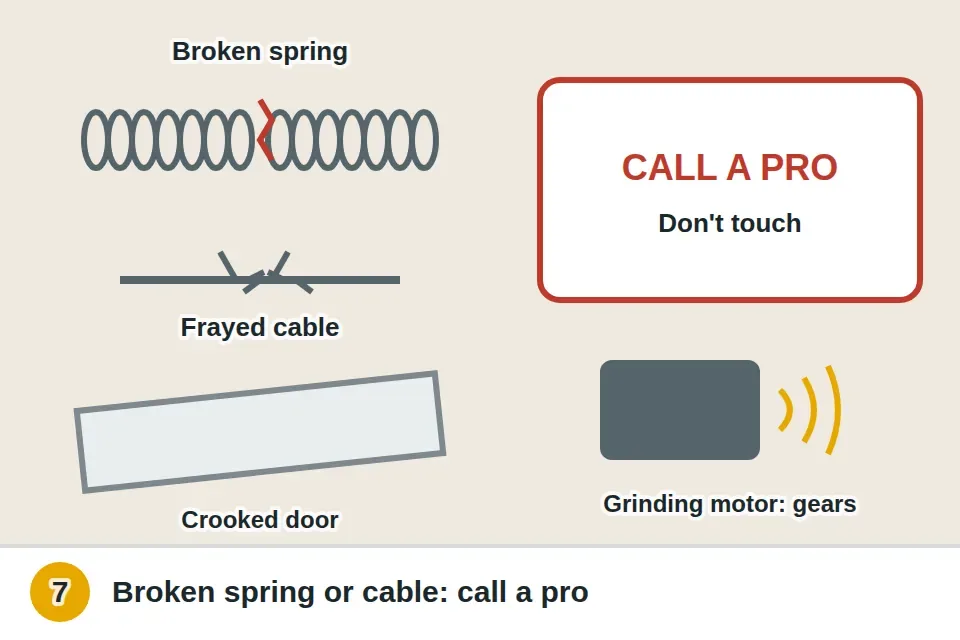
- Know when it's a spring or opener problemA loud bang when the door is closed and the door suddenly feeling very heavy usually means a torsion spring broke. A frayed cable, a door hanging crooked, or a squeal you can't fix with lubricant at the spring also mean it's time to call a pro. If the noise is a grinding or humming inside the opener motor itself, the opener's gears may be worn, and replacing the opener with a quieter belt-drive model is an option.
Watch it done
- The door runs quietly
- No rattling from the hinges
- The rollers turn smoothly
If the door has other problems
If the door goes back up instead of closing, see the guide for a garage door that won't close.
If the opener doesn't respond to the remote or wall button, check our guide for a garage door opener not responding.
What a pro typically charges (a rough estimate; prices vary by area): A garage door tune-up usually costs $100–$250. Replacing a full set of rollers runs about $150–$350, a torsion spring $200–$450, and a new belt-drive opener $400–$800 installed.
Find a handyman near youSomething else going on?
Noisy garage door questions
How do I make my garage door quieter?
Tighten the hardware, lubricate the hinges, roller bearings and springs, and replace worn rollers.
What should I use to lubricate a garage door?
A silicone or lithium spray made for garage doors. Don't rely on plain WD-40 as the lubricant.
Should I grease garage door tracks?
No. Wipe the tracks clean; grease in the track collects dirt and makes noise.
Can I replace garage door rollers myself?
The upper rollers, yes. The bottom rollers sit in brackets under spring tension, so leave those to a pro.
Why is my garage door squeaking?
Squeaks come from dry hinges, rollers and springs. Lubricate the hinges, roller bearings and springs, but keep lube out of the track.