Sump pump not turning on
A sump pump that won't turn on is usually a power problem or a stuck float, not a dead motor. Check that it has power, give the float room to move, and test it with a bucket of water. Do it before heavy rain, not during it. Pour the water slowly and watch the float rise. If it doesn't turn on by the time the float is near the top, you've found your problem.


How a sump pump works
A sump pump sits in a pit in the lowest part of the basement or crawl space. As groundwater fills the pit, a float rises and switches the pump on, and the pump pushes the water out through a pipe to the outside.
Most pumps plug into an outlet near the pit, and many of those outlets are -protected. When a pump doesn't run, it's often because that outlet tripped, got stuck against the pit wall, or debris is blocking the intake.
Why a sump pump won't run
A tripped GFCI, a breaker or a loose plug.
Pinned against the pit wall or tangled in the cord.
Mud and gravel block the pump's inlet.
Leaves, dirt or ice at the outside end.
| What you see | Likely cause | What to do |
|---|---|---|
| Nothing at all | No power | Reset the GFCI; check the breaker. |
| Doesn't start when the pit fills | Float is stuck | Unplug; free the float. |
| Runs but the pit stays full | Clogged intake or line | Clean the intake; check the pipe outside. |
| Hums, no water moves | Jammed or failed pump | Unplug; call a plumber. |
Get it pumping again
- Check the powerMake sure the pump is plugged in and the outlet has power. Press Reset on the outlet if it's a GFCI, and check the breaker. If the pump has a piggyback plug, where the float switch plugs in and the pump plugs into the back of it, make sure both are pushed in fully.

- Test it with a bucketSlowly pour a bucket of water into the pit. The float should rise and the pump should kick on, empty the pit, and shut off. If it does, it's working, and there may simply not have been enough water to trigger it.

- Free the floatIf it didn't start, unplug the pump. Look at the float: it should move up and down freely. Pumps that shift in the pit can pin the float against the wall, and the cord can tangle around it. Move the pump so the float has room.
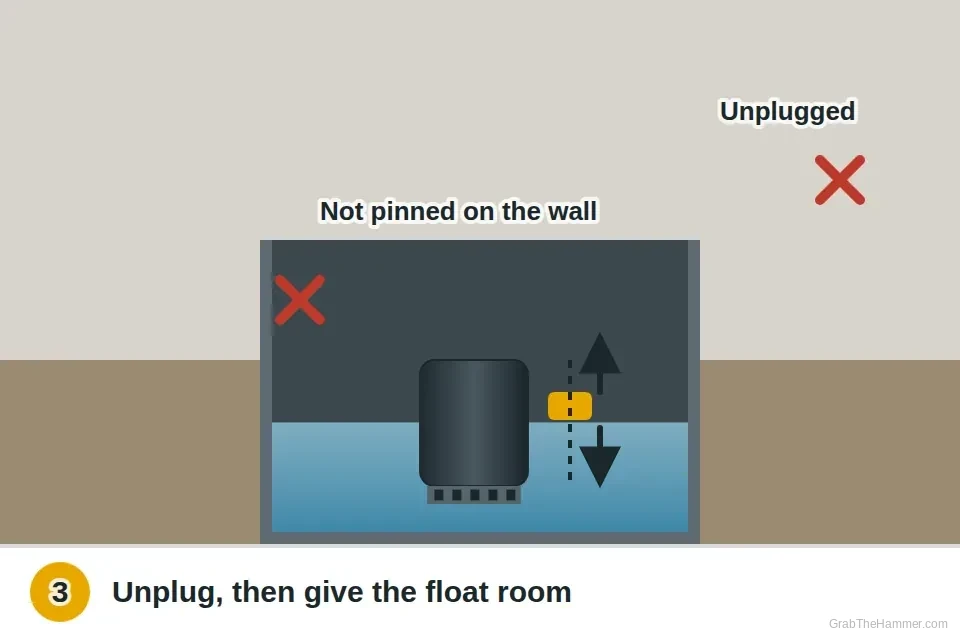
- Clean the pit and intakeWith the pump still unplugged, scoop out mud, gravel and debris from the bottom of the pit, and clear the screen or openings at the base of the pump so water can get in.

- Check the discharge lineFollow the pipe outside and make sure the end isn't blocked by leaves, dirt or ice. Inside, the check valve on the pipe should have its arrow pointing away from the pump, toward the outside.

- Plug it in and test againPlug the pump back in and repeat the bucket test. Watch that it turns on, empties the pit, shuts off, and doesn't keep cycling on and off.

Watch it done
- The pump kicks on when you pour a bucket into the pit
- It empties the pit and shuts off
- It doesn't keep cycling on and off
- Water flows out the end of the discharge line
If it still won't run right
If the pump runs but water comes back into the pit right away, the check valve may be stuck open or installed backward. A plumber can replace it quickly.
If it turns on and off every few seconds, the float switch may be set too close, or the check valve is letting water flow back. Many pumps last about 7 to 10 years; an older pump that starts acting up is often worth replacing.
What a pro typically charges (a rough estimate; prices vary by area): Replacing a sump pump often runs $500–$1,500 installed, depending on the pump and how easy it is to reach. A battery backup system typically adds a few hundred dollars more.
Find a plumber near you