Find your main water shutoff
If a pipe is leaking right now, stop reading after this line: the main shutoff is usually where the water line enters the house, often on the street-side wall, in the garage, or in the basement. Turn it clockwise, or turn the lever across the pipe. For everyone else, take ten minutes today to find it, so that you're not searching for it with water on the floor.

What's actually going on
Most people go looking for the shutoff for the first time while standing in an inch of water. It's a bad time to be reading your house like a treasure map. Take ten minutes today, find it, and make sure it actually turns. You'll probably never need it. But if you do, you'll be very glad you did this.
Why it happens
Most often in winter, in unheated spaces like garages, crawl spaces and exterior walls.
The flexible hoses feeding sinks, toilets and washing machines can burst without warning.
An old tank can split and dump dozens of gallons.
A slow drip at a joint that suddenly lets go.
Let's fix it
- Start where the water comes inIn warm climates it's often outside, on the wall facing the street, near a hose bib. In colder areas look in the basement or crawl space on the street-side wall, in the garage near the water heater, or in a utility closet.

- Follow the pipeLook for the thickest pipe, usually 3/4 or 1 inch copper or plastic, coming out of the ground or the slab. The valve sits on it, typically before it branches off.

- Try it, gentlyTurn it off, then open a faucet to confirm the water stops. Turn it back on slowly. A gate valve that hasn't moved in years can be stiff. Firm pressure is fine, but don't reef on it with a wrench.

- Label itHang a tag on it that says MAIN WATER SHUTOFF. Show everyone in the house, including anyone who house-sits.

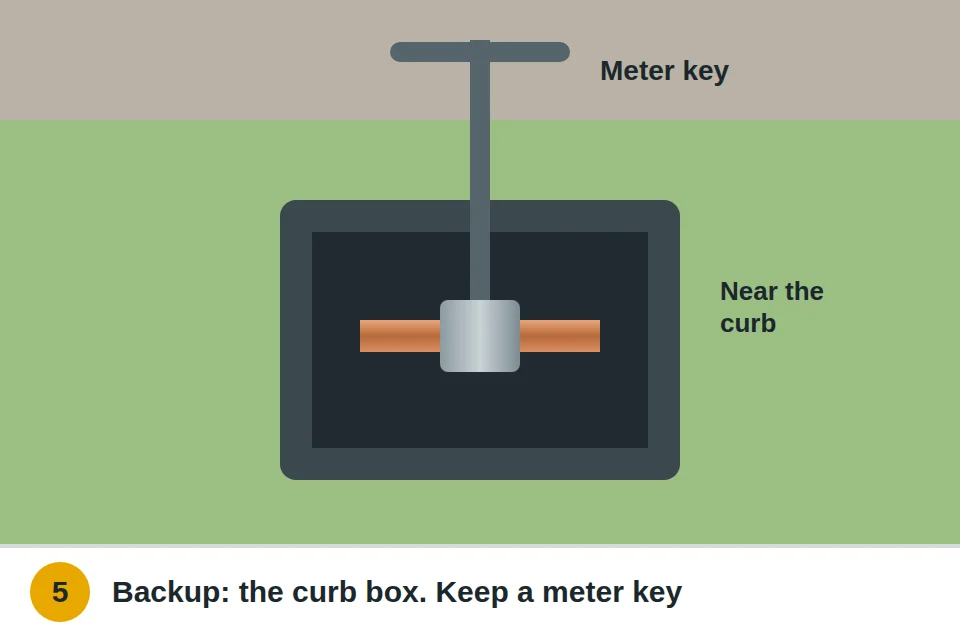
- Know your backupIf the house valve fails, the city shutoff is in the meter box near the curb. It usually needs a meter key, which costs about $15 at a hardware store and is worth keeping in the garage.
Still not fixed?
If the main valve won't budge or won't fully close, use the city shutoff in the meter box near the curb. You'll usually need a meter key.
Once the water is off, open the lowest faucet in the house to drain the lines and take pressure off the leak. Then turn off the water heater.
What a pro charges: Emergency plumber visits often cost $200–$500 or more after hours. Replacing a main shutoff valve usually runs $300–$700.
Common questions
How long can I leave the main water off?
As long as you need. Nothing is harmed by it being off, though your water heater shouldn't run a heating cycle while it's empty, so turn gas or power to it off if you'll be draining lines.
Why does water still trickle after I close it?
Some water is left in the pipes above the valve. Open the lowest faucet in the house to drain them. If it keeps flowing after a few minutes, the valve isn't sealing fully.
Can I just turn off the water to one fixture?
Usually, yes. Toilets and sinks have small shutoff valves underneath. Use those for a single leak, and the main shutoff for anything bigger.
How do I stop a leaking pipe temporarily?
Shut off the water first. A pipe repair clamp or self-fusing silicone tape can hold until a plumber arrives.