Humidifier not working or not putting out mist
A humidifier that stops putting out mist usually has a simple problem. The tank may not be seated on its valve, the float may be stuck, or the humidistat may think the room is already humid enough. If those check out, the next suspect is hard white mineral scale or a dried-out wick. Both are cheap to fix with white vinegar or a new wick. Unplug the humidifier before you clean or take anything apart, and let a warm-mist unit cool first.


How a room humidifier makes mist
Portable humidifiers come in three main types, and they all start the same way. Water sits in a tank on top of a base. When you set the tank down, a spring valve in its cap opens and lets water flow into the base until it's full. A small float in the base rises with the water. When the base runs low, the float drops and switches the mist off so the unit doesn't run dry. A humidistat, or humidity setting, turns the unit on and off to hold the level you pick, much like a thermostat does for heat.
What happens next depends on the type. An evaporative, or cool-mist wick, model draws water up a paper or fiber wick and blows air through it with a fan, so you feel moving air but see no visible mist. An ultrasonic model vibrates a small metal disc, called a transducer, so fast that it throws off a fine visible fog. A warm-mist model boils water with a heating element and releases steam. Minerals in tap water stay behind in all three. They build up as hard white scale on the valve, base, disc, element and wick, and that buildup is a frequent reason a humidifier slows down or stops.
Why the humidifier isn't misting
The valve stays closed and the base never fills.
Scale or gunk holds it down, so the unit thinks it's dry.
The room already reads drier than the setting would need.
Hard crust clogs the valve, base, disc or heating element.
An evaporative wick stops soaking up water.
The fan, disc, heater or board has failed.
| You notice | Likely cause | Start at |
|---|---|---|
| No lights, no fan, nothing | Power, tank or float | Step 1 |
| Runs, then shuts off with water left | Humidistat setting | Step 2 |
| Full tank, base stays dry | Scaled or stuck tank valve | Step 3 |
| Fan blows but room stays dry | Dry or crusted wick | Step 4 |
| Light on, little or no mist | Scale on disc or heating element | Step 5 |
| Smells musty or still won't mist | Needs disinfecting or replacing | Step 6 |
Let's fix it
- Check power, water and the tankStart with the free checks. Plug the humidifier straight into a wall outlet you know works, and press the power button. Some units have a reset or auto-off after the tank runs empty. Empty the tank, refill it with cool water and screw the cap on snugly. Set the tank back on the base and press down until it sits flat and level. Many units won't run if the tank is crooked or the base sits on a tilted surface. Wait a minute for water to flow into the base. Then lift the tank and look: the base should have water in it and the float should be riding up.

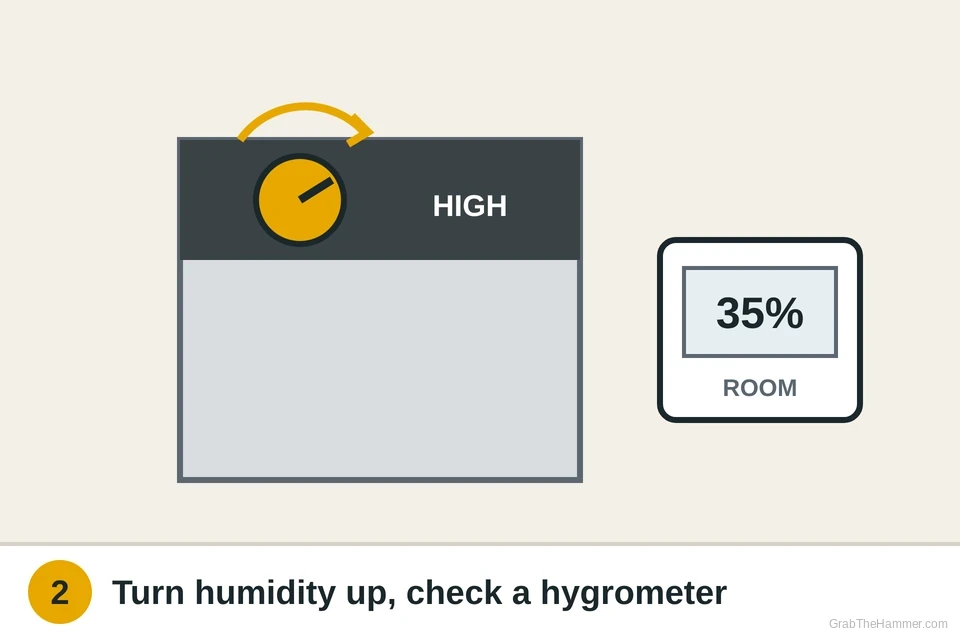
- Check the humidistat against the roomIf the unit runs for a while and then stops with water still in the tank, the humidistat may be doing its job. It shuts the mist off once the room reaches the setting. The built-in sensor sits near the unit, so it can read higher than the rest of the room. Turn the humidity knob or setting all the way up, or switch to continuous mode, and wait 5 minutes. If mist starts, the unit works. A cheap digital hygrometer, often around $10 to $15, shows the real room level. The EPA suggests keeping indoor humidity between 30 and 50 percent, so you don't need it higher than that.
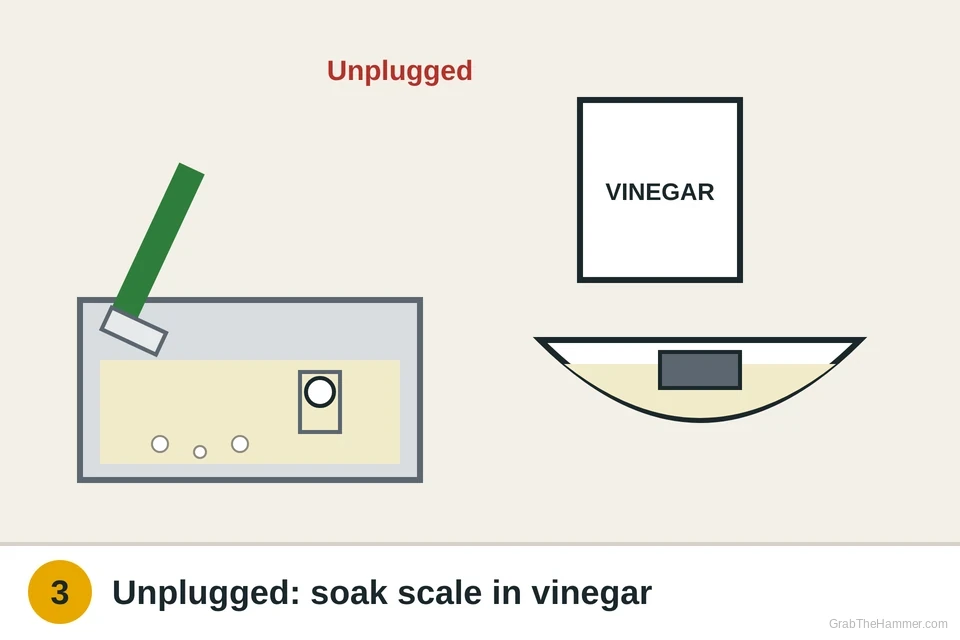
- Soak scale off the valve and baseUnplug the unit and empty it. Unscrew the tank cap and look at the spring valve in the middle. Press the pin in with a finger; it should spring back freely. Hard white crust on the valve, in the base or around the float can hold them shut. Pour plain white vinegar into the base, enough to cover the crusty spots, and soak the cap in a bowl of vinegar too. Leave them about 20 to 30 minutes, or as your manual says. Scrub with a soft brush or old toothbrush, then rinse well with clean water until the vinegar smell is gone. Lift the float and make sure it moves up and down.
- Replace a dry or crusted wickThis step is for evaporative models, the ones with a fan and no visible mist. Unplug the unit, lift off the top and pull out the wick, a tall paper or fiber filter that stands in the water tray. A good wick is soft and soaks up water. If it's stiff, crusty white at the top, or brown or smelly, it can't wick water anymore. Many makers suggest replacing it every 1 to 3 months in use, but check your manual. Buy the wick that matches your model number, usually about $8 to $20. Let a new wick soak in the tray for about 30 minutes before you turn the fan on.

- Clean the disc or heating elementUnplug the unit and, for warm mist, let it cool fully, often about 30 minutes. On an ultrasonic model, find the small round metal disc in the bottom of the base, usually under the float. White crust on it stops the fog. Cover it with white vinegar for about 20 to 30 minutes, then wipe it gently with a soft cloth or soft brush. Don't scrape it with metal or anything hard; the coating scratches. On a warm-mist model, descale the heating chamber or element with vinegar the way your manual says. Never submerge a base that holds the motor or wiring. Rinse well, keep water away from the control panel, and let it dry before you plug it back in.

- Disinfect, switch water, or replace itOnce it mists again, keep it clean. The EPA suggests emptying the tank and drying the inside daily, and cleaning every third day. Follow your manual for disinfecting; some allow a diluted bleach rinse. If you use bleach, rinse until there's no smell before using vinegar or running the unit. Never mix the two. White dust on furniture comes from minerals in tap water; distilled water, or a demineralization cartridge if your model takes one, cuts it down. Replace the humidifier if it still won't mist after cleaning, the plastic is cracked, or it smells musty after disinfecting. A new one often costs about $30 to $80.

Watch it done
- Water flows into the base when you set the tank down
- Steady mist or moving moist air comes out on the high setting
- The tank level drops over a few hours of use
- It shuts off on its own only when the room reaches your setting
Still no mist after cleaning, or it smells musty? Replace the humidifier.
If it comes back
If the mist fades again after a few weeks, scale is building back up. Hard tap water does this fast. Switching to distilled water and rinsing the base every few days usually slows it down. If your whole house has hard water, see the guide for a water softener that isn't working.
If the humidifier works but the windows drip or fog every morning, the room is too humid. Turn the setting down and see the guide for condensation on windows.
If the opposite is your problem and a damp room needs drying out, see the guide for a dehumidifier that isn't collecting water. For a room that won't stay warm in dry winter air, see the guide for a room that's too hot or cold.
What a pro typically charges (a rough estimate; prices vary by area): A replacement wick usually costs about $8–$20. A new portable humidifier often costs about $30–$80, and larger whole-room models more.
Shop for a replacement humidifier