Stop a washing machine from shaking or walking
A washer that bangs or creeps across the floor during the spin cycle is usually uneven: an unbalanced load, feet that aren't level, or, on a new machine, shipping bolts that were never removed. All three are free to fix, and checking them in that order takes about 20 minutes.
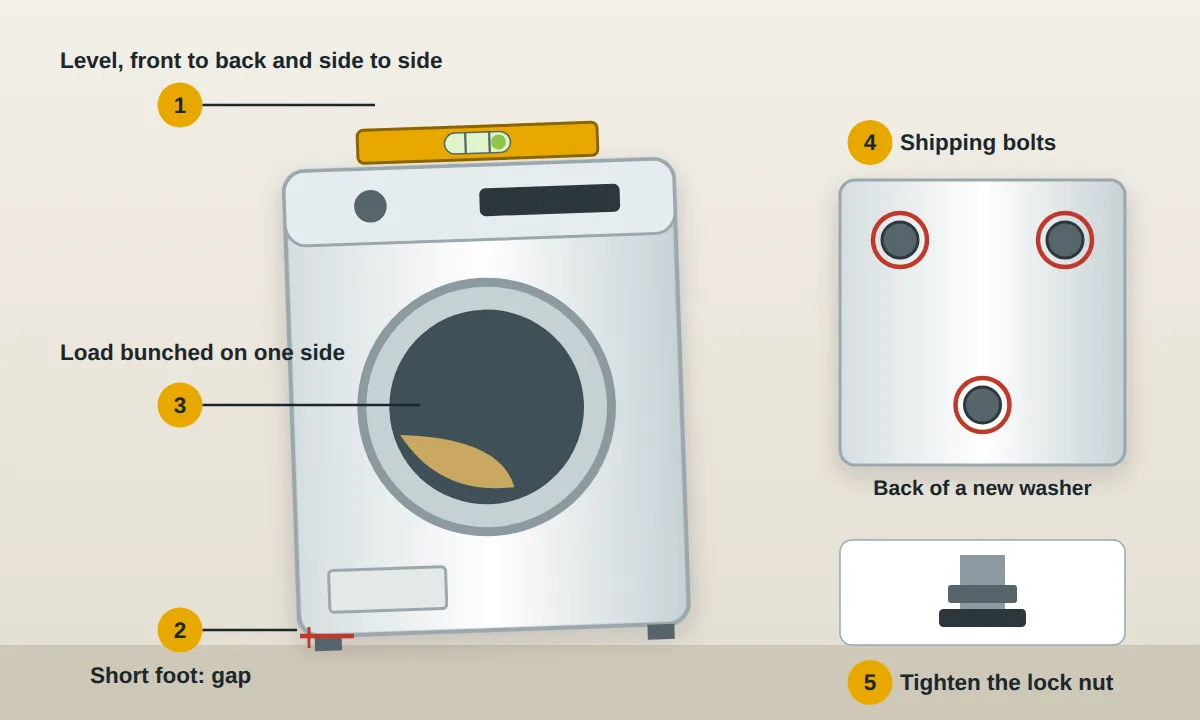
Why spinning makes it shake
During the spin cycle, the drum turns fast enough that a small imbalance becomes a big force. If one foot is a little short, or the wet laundry is bunched on one side, the whole machine rocks, and each rock pushes it a little further across the floor.
New washers ship with bolts through the back that lock the drum in place for transport. Left in, they make the machine shake hard from the very first spin, so they need to come out before the first load.
What makes a washer shake
One heavy item, or a load bunched on one side.
A foot that's too short or has crept loose.
A new machine shakes hard until they're removed.
Upper floors and older wood floors can bounce. Anti-vibration pads help a little.
The shocks or springs that hold the drum wear out over the years.
| When it happens | Likely cause | Fix |
|---|---|---|
| Only with bulky or very small loads | Unbalanced load | Rebalance; add towels. |
| From the very first load | Shipping bolts still in | Remove them following the manual. |
| It rocks when you press a corner | Uneven feet | Level the feet and lock them. |
| Every load, level and balanced | Worn suspension or a flexing floor | Check the drum; call for repair. |
Let's fix it
- Stop and rebalance the loadPause the cycle, open the door once it unlocks, and spread the laundry evenly around the drum. A single heavy item like a bath mat or a comforter is often the cause.

- Check for shipping boltsOn a new or recently moved washer, look at the back for bolts with plastic spacers. Remove them following the manual, and keep them for the next move.

- Check that it's levelSet a level across the top, front to back and side to side. Then press down on each corner. If it rocks, one foot isn't touching the floor.

- Adjust the feetLoosen the lock nut on a front foot, turn the foot to raise or lower that corner, then tighten the lock nut against the cabinet so it can't creep. On many top-loaders the rear feet adjust themselves: with the washer empty, tilt it forward a few inches and set it back down.

- Test with a spin cycleRun a rinse and spin with a few towels spread evenly. It should hum and vibrate a little, but not bang or move.

If it still bangs with a balanced load
If it's level and the load is balanced, push down firmly on the top edge of the drum through the door. It should spring back without bouncing. A drum that bounces or sags may have worn shocks or springs.
If the floor itself flexes when you walk near the washer, pads under the feet help. On a weak floor, a carpenter can advise on stiffening it.
What a pro typically charges (a rough estimate; prices vary by area): An appliance repair visit typically costs $100–$200. Replacing washer shocks or suspension springs usually runs $150–$350.
Other laundry problems
Shaking washer questions
Is it normal for a washer to shake during spin?
A little vibration is normal. Banging, rocking or moving across the floor isn't.
Can a shaking washer damage anything?
It can. Repeated banging wears the suspension, can loosen hoses and can damage the floor or nearby walls.
Do anti-vibration pads work?
They help on hard or slightly uneven floors, but they won't fix an unbalanced load or a washer with its shipping bolts still in.
Why does it walk only on some loads?
Small loads and single heavy items, like a rug or a pair of jeans on their own, are the hardest to balance. Add a few towels.
Still stuck? Ask us
Tell us what you're seeing and what you've tried. We read every question, and the ones that will help other people get answered on this page.