Fix a crooked or sagging cabinet door
A cabinet door that hangs crooked, sticks out, or rubs its neighbor usually just needs its hinges adjusted. Most modern kitchen cabinets have hinges with small adjustment screws that move the door side to side, up and down, and in and out. All it takes is a screwdriver and a few minutes. Turn each screw a quarter turn at a time and check. It's surprisingly easy to overcorrect and end up chasing the door around.


How cabinet hinges adjust
Most kitchen cabinets built in the last few decades use concealed hinges: a round cup set into the back of the door, attached to a mounting plate on the inside of the cabinet. Each hinge has screws for adjusting the door's position.
Doors drift out of line as screws loosen with use, or when someone hangs on an open door. Tightening and adjusting puts them back. Older cabinets with visible hinges on the outside don't have adjustment screws, but tightening and shimming usually works.
Why cabinet doors go crooked
The most common reason doors drift.
Screws spin and won't hold.
Pulls the hinge out of line.
Humidity can bend thin doors.
| The door is | Adjust | How |
|---|---|---|
| Tilted or uneven with its neighbor | Side to side | Screw nearest the door |
| Too high or too low | Up and down | Mounting plate screws |
| Sticking out at the top or bottom | In and out | Screw at the back of the arm |
| Loose and wobbly | Loose screws | Tighten; fill stripped holes |
Line it back up
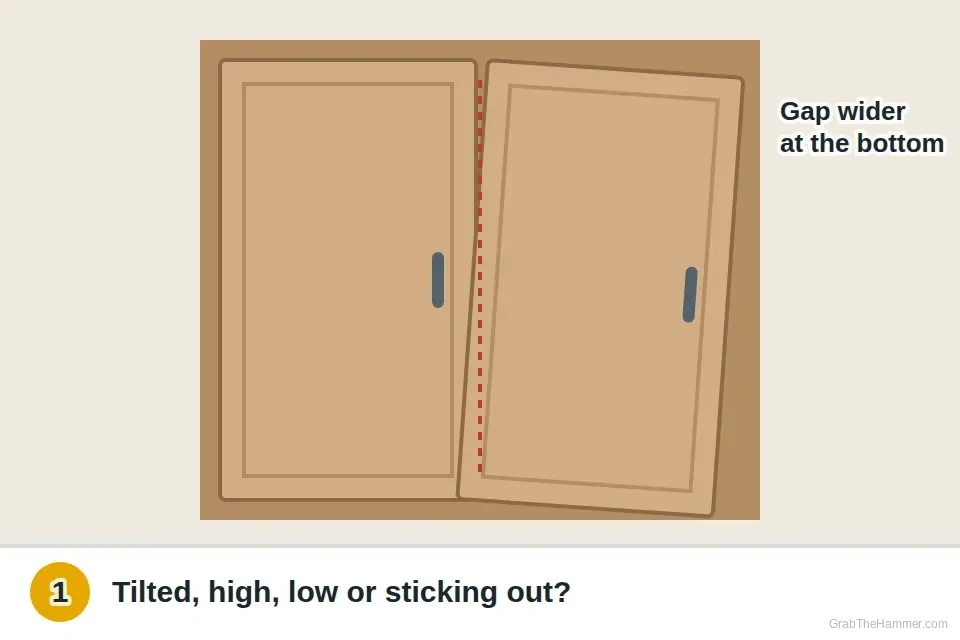
- Look at the gapsClose the doors and look at the gaps between them and along the top. Note what's wrong: tilted, too high or low, or sticking out at the top or bottom. That tells you which screw to turn.
- Tighten the loose screwsOpen the door and tighten the screws that hold the hinge to the door and the mounting plate to the cabinet. If a screw just spins, fill the hole with glued toothpicks, snap them off flush, let the glue set and drive the screw back in.

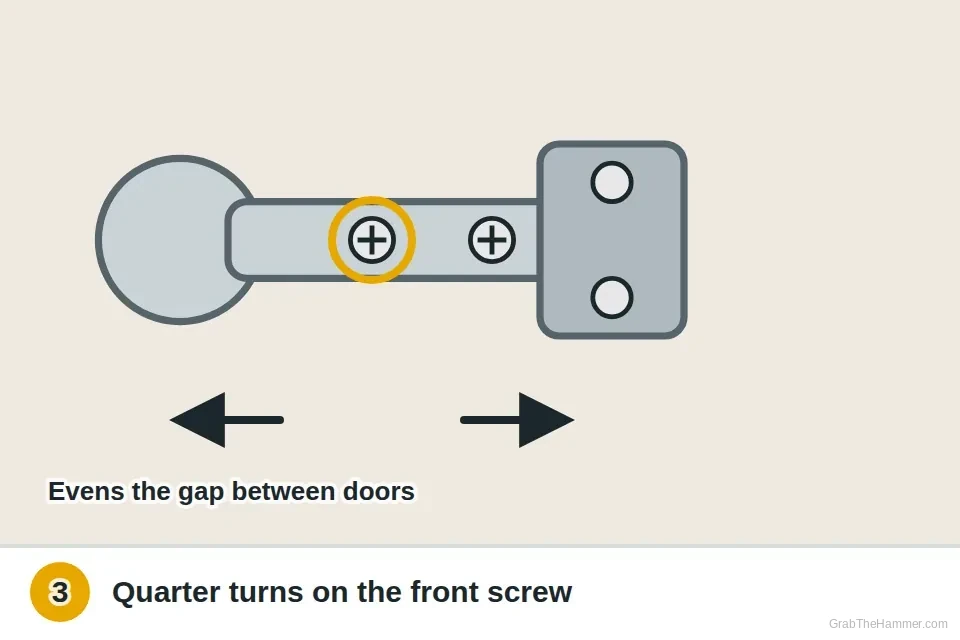
- Adjust side to sideFind the on the hinge arm, usually the one nearest the door. Turn it a quarter turn at a time on one hinge to tilt the door, or on both hinges to shift the whole door, until the gap between doors is even.
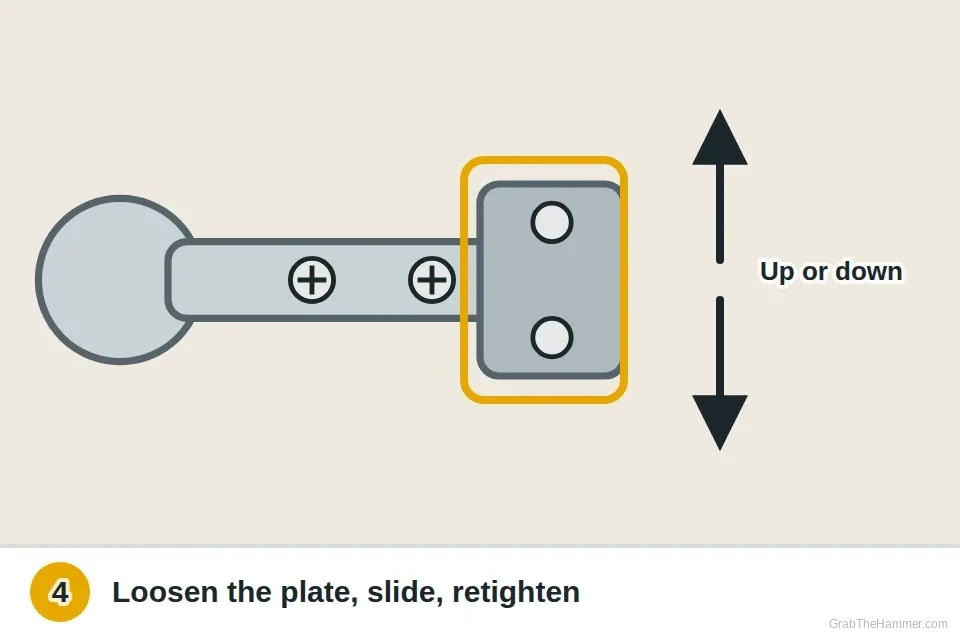
- Adjust up and downLoosen the mounting plate screws slightly, slide the door up or down, and retighten. Some plates have a small cam screw that does the same thing without loosening.
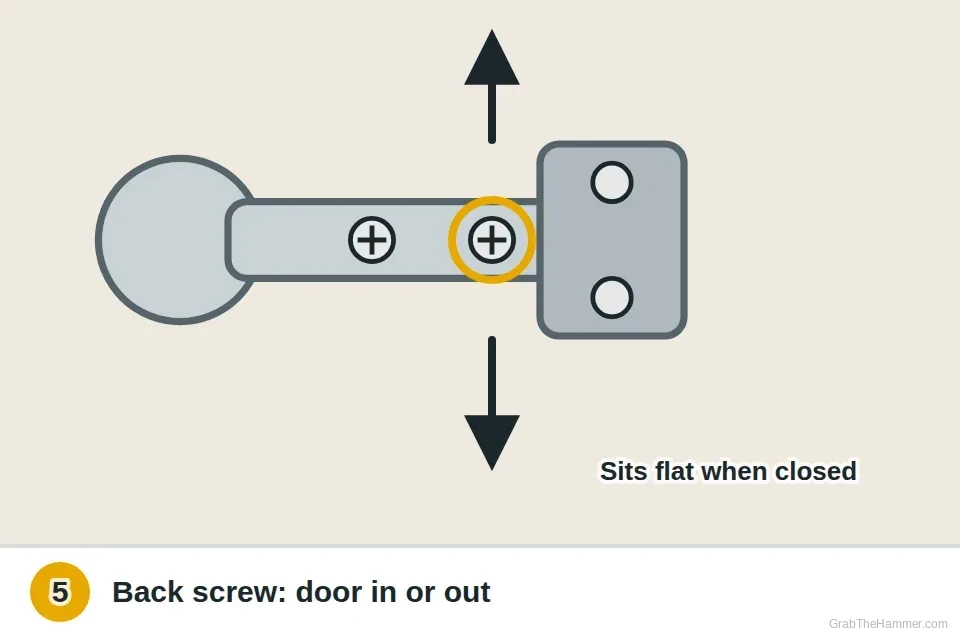
- Adjust in and outIf the door sticks out at the top or bottom, turn the screw toward the back of the hinge arm. It moves the door closer to or farther from the cabinet so it sits flat when closed.
- Check it and repeatClose the door, look at the gaps again and fine-tune. Work in small turns; each change on one hinge affects the whole door. Line up neighboring doors to each other, not just to the cabinet.

Watch it done
- Gaps between doors and along the top are even
- The door sits flat against the cabinet when closed
- Neighboring doors line up with each other
If it still won't line up
If a knob or handle keeps coming loose, check our guide for a loose cabinet knob or handle.
If one corner won't come in line no matter what, lay a straightedge across the door. A warped door may need replacing, or a third hinge in the middle can pull it flat.
If a hinge is cracked or won't hold its setting, replace it with one of the same type. Take the old one to the store to match it.
What a pro typically charges (a rough estimate; prices vary by area): A handyman typically charges $75–$150 to adjust or replace cabinet hinges, depending on how many doors.
Find a carpenter near you