Kitchen faucet sprayer not working
A kitchen faucet sprayer not working usually comes down to mineral buildup in the head, a hose that's kinked or twisted under the sink, or a diverter that's stuck. The same few checks cover both side sprayers and pull-down sprayers. Start with the sprayer head, since cleaning it fixes weak or sputtering spray more often than anything else, then work your way under the sink. If the hose or head is cracked or leaking, a replacement is usually an easy swap. Sprayers clog with scale the same way aerators do. A vinegar soak fixes more of them than any part.


How a faucet sprayer works
A side sprayer sits in its own hole next to the faucet and connects by a hose to the faucet body. When you squeeze the trigger, the drop in pressure lets a small part called the diverter send water to the hose instead of the spout. If the diverter is clogged or worn, water keeps coming out of the spout, or the spray is weak.
A pull-down or pull-out sprayer is the spout itself. Its hose runs down through the faucet and under the sink, where it clicks into the supply with a quick-connect fitting, and a weight on the hose pulls the head back into place. A button on the head switches between stream and spray. Most problems with these are mineral buildup in the head, or a hose that's caught, twisted or not fully clicked in.
Why the sprayer stops working
Scale clogs the spray holes and the screen.
The hose is pinched under the sink or the weight has slipped.
Water won't switch from the spout to a side sprayer.
Water leaks at the head, the quick-connect or the hose itself.
| You notice | Likely cause | Start at |
|---|---|---|
| Spout and sprayer both weak | Problem upstream of the sprayer | Step 1 |
| Spray sputters or shoots sideways | Mineral buildup in the head | Step 2 |
| Pull-down head won't retract | Hose caught or weight slipped | Step 3 |
| No water at all from a pull-down | Kinked hose or loose quick-connect | Step 4 |
| Side sprayer won't switch from spout | Stuck diverter | Step 5 |
| Drips where head meets hose | Worn washer or O-ring | Step 6 |
| Water running down the hose | Cracked hose | Step 7 |
Let's fix it
- Figure out where the problem isTurn on the faucet with the sprayer off. If the regular stream is also weak, the problem is upstream of the sprayer, so check the shutoff valves under the sink are fully open and we have a guide for low pressure from one faucet. If only the sprayer is weak, won't switch, or leaks, keep going. Note whether you have a separate side sprayer or a pull-down head, since a couple of steps only apply to one type.

- Clean the sprayer headMineral deposits clog the tiny holes in the spray face. Unscrew the head from the hose if it comes off (make sure the faucet is off, and hold the hose so it doesn't slip back down), or tie a bag of white vinegar around it with a rubber band so the face is submerged. Let it soak for an hour or more, then scrub the face with an old toothbrush and rub the rubber nozzles with your thumb to break loose any scale. Many heads also have a small screen or aerator where they connect to the hose; rinse that out too.

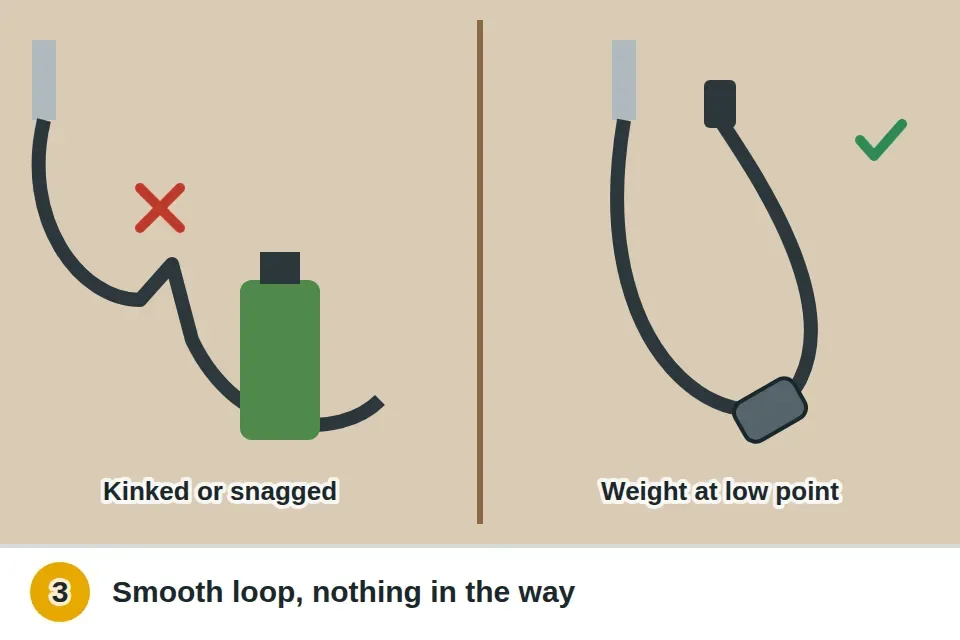
- Check the hose under the sinkEmpty the cabinet and pull the sprayer out while you watch the hose. Look for kinks, sharp bends, or a hose that's twisted around the supply lines or caught on items stored in the cabinet. On a pull-down faucet, make sure the weight is clamped on the hose at the low point of its loop and hasn't slid down to the connection, which can keep the head from retracting. Straighten the hose so it moves freely.
- Reseat the quick-connect fittingOn pull-down faucets, the hose clicks into a fitting on the faucet's supply line. Turn off both shutoff valves first. Squeeze the release tabs or pull back the collar, separate the fitting, and check the O-ring for damage or grit. Push it back together until it clicks, tug on it to be sure it's locked, then turn the water back on and check for drips.

- Clean or replace the diverter on a side sprayerIf water keeps coming out of the spout when you squeeze a side sprayer, the diverter is the likely cause. Turn off both shutoff valves and open the faucet to release pressure. On many single-handle faucets you remove the handle and spout to reach a small diverter valve in the faucet body; on others it sits where the sprayer hose connects. Soak it in vinegar, rinse it and reinstall it, or replace it with the exact part for your faucet, so check the model number or bring the old one to the store.

- Fix leaks at the hose or headDry everything, then run the sprayer while you watch with a flashlight. Drips where the head meets the hose usually mean a worn washer or O-ring inside the connection, which is cheap to replace. Water running down the hose under the sink or out of a crack means the hose itself has failed. Put a towel and bucket under the sink while you check.

- Replace the hose or sprayer headTurn off the water, disconnect the old hose at the quick-connect or the faucet body, and pull it out through the faucet or sprayer base. Many faucet makers sell replacement hoses and heads for their own models, and universal side sprayer kits are common at hardware stores. Match the connection type and length, feed the new hose through, attach it hand-tight (on metal fittings, add a small turn with a wrench; plastic and quick-connect fittings are hand-tight only), then turn the water on slowly and test.

Watch it done
- Strong, even spray
- The sprayer pulls out and retracts smoothly
- No drips under the sink
Still weak with a clean head? The faucet cartridge may be clogged.
If the sprayer still won't work
If the sprayer is clean, the hose is straight and the diverter is new but flow is still weak, the cartridge or valve inside the faucet may be partly clogged. See the guide for a dripping faucet for how to get at the cartridge, or consider replacing the faucet.
If you find water in the cabinet but can't tell where it's coming from, dry everything and run each part separately. Check our guide for a leak under the sink.
What a pro typically charges (a rough estimate; prices vary by area): A plumber usually charges $150–$350 to replace a sprayer hose, head or diverter, much of which is the service call. Replacing the whole kitchen faucet typically runs $250–$600 installed, depending on the faucet.
Find a plumber near youSomething else going on?
Faucet sprayer questions
Why is my kitchen sprayer so weak?
Usually mineral buildup in the sprayer head, or a kinked hose under the sink. Soak the head in vinegar first.
Why does water still come out of the faucet when I use the sprayer?
On a side sprayer, the diverter valve is likely stuck or worn.
Can I replace just the pull-down sprayer hose?
Often yes. Many faucet makers sell replacement hoses for their models.
Why won't my pull-down sprayer retract?
The weight on the hose may have slipped, or the hose is caught under the sink.
Why is my faucet sprayer weak?
Mineral buildup in the head is the most common cause. Soak the spray head in vinegar.