Blinds won't go down or stay up
Most horizontal blinds that won't come down, won't stay up or hang crooked have a problem in the cord lock, a small mechanism in the headrail that grips the lift cords. Often it's just a matter of releasing the lock the right way, or evening out lift cords that slipped. Cordless blinds have a spring motor that sometimes needs resetting. A worn cord lock is a cheap part you can swap in about 20 minutes. Before you start, keep in mind that loose cords are a strangulation hazard for young children, so tie them up out of reach when you're done.


How blinds go up, down and stay put
On a corded horizontal blind, two or more lift cords are tied to the bottom rail and run up through holes in each slat, across the inside of the headrail and out through the cord lock at one end. When you pull the cords, they lift the bottom rail and stack the slats. The cord lock has a small toothed roller or pin that slides into a narrow slot when the cords are pulled toward the outside edge of the window, pinching the cords so the blind stays put. Pulling the cords toward the middle lets the pin drop away from the cords so they can slide freely, and the blind lowers by its own weight.
Problems come from that small mechanism and the cords around it. If you pull at the wrong angle, the lock never releases. If one cord slips or gets caught in the headrail, one side goes up and the other doesn't. Dust, a frayed cord or a worn pin can stop the lock from gripping, so the blind slides down. Cordless blinds replace all of this with a spring motor in the headrail that balances the blind's weight; if it's lowered partway too often or pushed past its stop, the spring gets out of balance and the blind sticks or won't stay where you leave it.
Why blinds get stuck
The lock only releases when the cords move toward the middle.
Closed slats rub and add drag on the cords.
One cord slipped or tangled, so one side hangs low.
The pin won't grip, so the blind slides down.
Needs a full up-and-down reset.
| You notice | Likely cause | Start at |
|---|---|---|
| Won't come down at all | Lock not released | Step 1 |
| Hard to pull, slats closed | Slats dragging | Step 2 |
| One side higher than the other | Uneven or tangled cords | Step 3 |
| Slides down after you let go | Cord lock not gripping | Step 4 |
| Cordless blind stuck or drifting | Spring needs a reset | Step 5 |
| Cord frayed or lock broken | Replace the cord lock or cord | Step 6 |
Let's fix it
- Release the cord lock the right wayStand in front of the blind and hold all the lift cords together. Pull them gently straight down an inch or two to take the weight off the lock, then swing them toward the middle of the window, at about a 45 degree angle from the headrail. You should feel the lock release. Keeping the cords angled toward the middle, let them slide up slowly through your hand as the blind lowers. To stop it, swing the cords back toward the outside edge and let go. If it still won't move, the lock may be jammed; look in the end of the headrail for a cord caught on the side of the lock.

- Open the slatsTurn the tilt wand or pull the tilt cords until the slats are level and open, so you can see through them. Closed slats press against the lift cords and the ladder strings, which adds friction and can make the blind hard to raise or lower, or stop it from going down evenly. With the slats open, try raising and lowering again. On faux wood and wood blinds, which are heavy, it's especially important to have the slats open before lifting.

- Even out uneven cordsIf one side hangs lower, lower the blind all the way so the bottom rail rests level and the cords go slack. Then pull each lift cord individually at the cord lock, looking for one that's longer or shorter than the others; the lower side has the longer cord. With the blind fully down and the bottom rail level, pull the long cord until it matches the others. Then re-tie the cords together at the pull or the equalizer, the small plastic piece that joins them, at the same length. Don't tie the cords together lower down, which creates a loop a child can get caught in. If a cord is caught inside the headrail, take the blind down (it usually unclips from its brackets) and free the cord from wherever it's wrapped or jammed.

- Clean or replace a cord lock that won't holdIf the blind slides down after you let go, the cord lock isn't gripping. Take the blind down: open the bracket covers or swing them open and slide the headrail out. Look into the cord lock at the end of the headrail. Blow or brush out dust and lint, and check that the small toothed pin or roller moves freely in its slot. A cord worn smooth or frayed where it passes the lock also slips. If cleaning doesn't help, replace the cord lock with one that matches the headrail's size and style, typically $5 to $10; most press or snap into a cutout, sometimes with a screw. Re-thread the cords through it in the same order.

- Reset cordless blindsCordless blinds have a spring motor that can lose its balance if you often stop them partway. To reset, push up on the center of the bottom rail and raise the blind all the way to the top, then pull it all the way down to the fully extended position. Repeat this two or three times, keeping both hands near the middle of the rail so it goes up evenly. Many makers say to raise and lower the blind fully every so often to keep the spring balanced. If the blind won't come down, push it up first to release the brake, then pull down gently from the center.

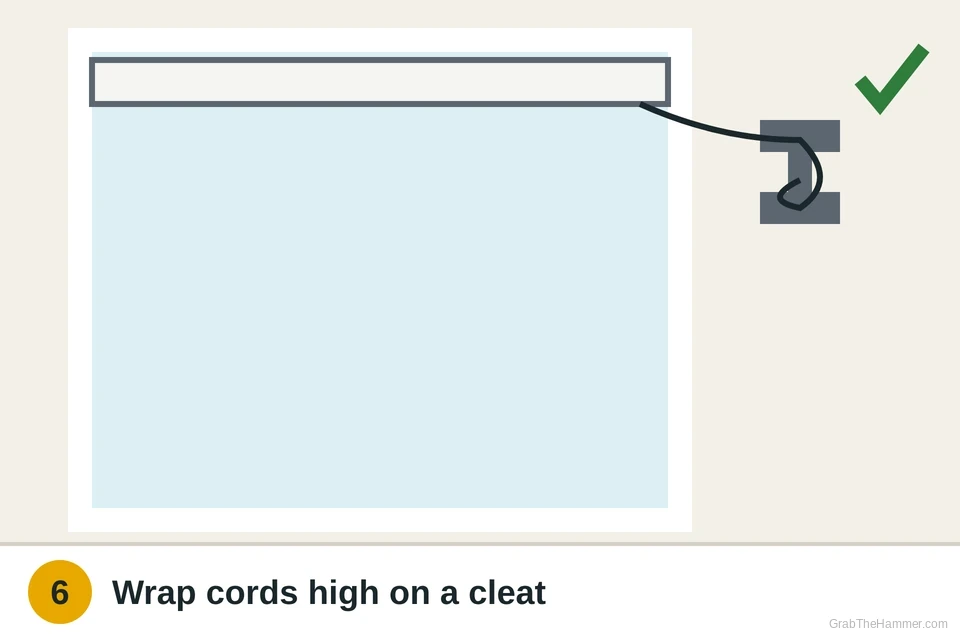
- Make it safe, or replace the blindOnce the blind works, tie up or wrap long cords on a cord cleat mounted high on the window frame, well out of a child's reach, and make sure inner cords can't be pulled out into a loop. If cords are badly frayed, a slat is broken in a way that blocks the cords, or a cordless spring won't hold after resetting, replacing the blind is often easier than restringing it. Many inexpensive blinds cost less than replacement parts and an afternoon of restringing. For homes with young children, cordless or motorized blinds remove the cord hazard.
Watch it done
- The blind lowers smoothly when you angle the cords toward the middle
- It stays exactly where you lock it
- The bottom rail hangs level
- Cords are wrapped up out of reach
Still slipping or crooked? Replace the cord lock, or the blind.
If it comes back
If the blind keeps going crooked, one cord is likely slipping in the cord lock or caught on a slat. Check the cords at the headrail again, and make sure the slats are open when you raise it.
If it's the window sash that won't stay up, not the blind, see the guide for a window that won't stay open. For a window that's hard to open at all, see the guide for a window that sticks.
If drafts around the window make the blinds sway, see how to stop drafts around windows.
What a pro typically charges (a rough estimate; prices vary by area): A blind repair service typically charges about $50–$150 per blind to restring or replace parts, and more for motorized or custom shades.
Find a blind repair service near you