Storm door won't close
A storm door that won't close all the way, slams, or closes but won't latch usually needs a small adjustment to its closer, the air-filled tube near the top or bottom of the door. A screw on the end of the closer sets how fast it closes, and the strike plate on the frame sets whether the latch catches. If that doesn't do it, look for a loose bracket, a door dragging on its sweep, or a closer that's worn out. One screw on the end of the closer fixes most storm doors.


How a storm door closer works
Most storm doors use one or two pneumatic closers. Each is a cylinder with a spring and piston, pinned to a bracket on the door frame at one end and a bracket on the door at the other. The spring pulls the door shut, and air escaping through a small adjustable valve slows it down. A square washer on the closer's rod is the hold-open washer; slid against the cylinder with the door open, it keeps the door from closing.
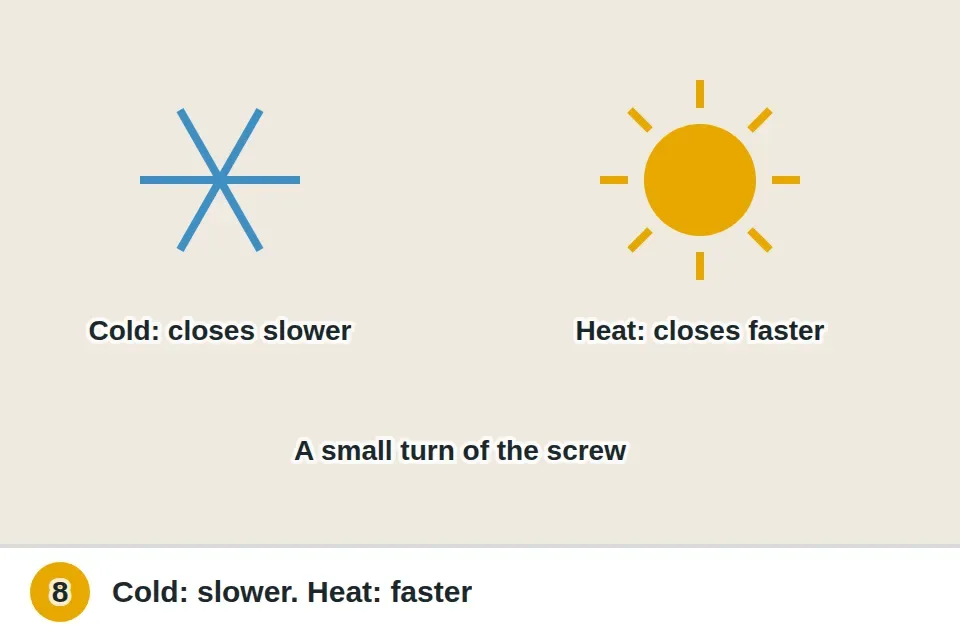
A wind chain or a second spring usually runs alongside to stop the door from swinging too far open. When a gust catches a door without one, it can bend the closer rod or pull the frame bracket out of the wood. Temperature changes matter too: closers often close slower in cold weather and faster in heat, so a door that worked in summer may stall in winter.
Why storm doors won't close
The speed screw is set too slow or too fast.
The closer can't pull against the frame.
The door reaches the frame but won't catch.
Slams, leaks or bends after wind.
| You notice | Likely cause | Start at |
|---|---|---|
| Door stays open | Hold-open washer engaged | Step 1 |
| Stops short of the frame | Closer set too slow | Step 2 |
| Slams shut | Closer set too fast | Step 2 |
| Bracket wobbles or pulled out | Stripped screws | Step 3 |
| Touches the frame but won't catch | Strike out of line | Step 4 |
| Scrapes the threshold | Bottom sweep too low | Step 5 |
| Slams no matter the setting | Worn closer | Step 7 |
Let's fix it
- Release the hold-open washerLook at the square washer on the closer's rod. If it's slid up against the cylinder, it's holding the door open. Open the door a little wider and the washer should drop loose; slide it back toward the door end of the rod. If it won't release, the rod may be bent, which means a new closer.

- Adjust the closing speedFind the adjustment screw in the end cap of the , usually the end mounted to the frame bracket on the hinge side. Turn it clockwise to slow the door, counterclockwise to speed it up, a quarter turn at a time, testing after each turn. If the door stops short of latching, speed it up a little. If it has two closers, adjust both by the same amount so they work together.

- Tighten the bracketsCheck the bracket on the door frame and the bracket on the door. Tighten any loose screws. If a frame bracket screw just spins, the wood is stripped: fill the holes with glue-dipped toothpicks and let them set, or use longer screws that reach solid wood. A bracket that keeps pulling out may need to move slightly to fresh wood, using the closer's instructions for spacing.

- Adjust the latch and strikeIf the door reaches the frame but won't catch, watch where the latch meets the strike plate on the frame. Loosen the strike screws, shift it up, down or outward until the latch drops in, and retighten. Spray a little silicone into the latch so it snaps freely. Check that the door's latch isn't set to lock or hold open.

- Check for dragging and loose hingesOpen and close the door slowly by hand with the closer set to its fastest, or disconnected after you lock the hold-open washer and pull the door-end pin. If the bottom sweep drags on the threshold, loosen the screws on the bottom expander, the adjustable channel at the base of the door, raise it slightly and retighten. Tighten the screws along the hinge rail, since a sagging door can bind in the frame.

- Replace the wind chainIf the chain is stretched, broken or missing, replace it with a wind chain kit from a hardware store. Attach it between the door and frame brackets so it stops the door before it swings far enough to strain the closer or hinge. A chain with a spring helps soften the stop when wind catches the door.

- Replace a worn closerIf the door slams no matter how you set the screw, the closer leaks oil, or the rod is bent, replace it. Measure the old closer's length and match it, along with its duty rating, standard or heavy duty, to the door's weight. Open the door and lock the hold-open washer, then pull the pins and remove the old closer. Pin the new one into the same brackets, release the washer, and set the speed.

- Fine-tune with the seasonsClosers change with temperature, so check the speed when the weather turns cold and again when it gets hot. A small turn of the screw is usually all it takes. Swapping the glass panel for the screen, or the reverse, also changes the door's weight and may need a touch-up.
Watch it done
- The door closes on its own and latches
- It doesn't slam
- The brackets stay put when it closes
If it's the main door
If the main entry door behind it sticks or won't latch, check our guide for a door that won't latch.
If cold air comes in around the main door, there's a separate guide for weatherstripping a door.
What a pro typically charges (a rough estimate; prices vary by area): A handyman typically charges $75–$150 to adjust or replace a storm door closer, $100–$200 to repair a stripped or rotted spot where a bracket mounts, and $300–$700 to install a new storm door with the door included.
Find a handyman near youSomething else going on?
Storm door closer questions
How do I adjust a storm door closer?
Turn the screw on the end of the closer cylinder: clockwise to slow it, counterclockwise to speed it up, a quarter turn at a time.
Why won't my storm door close all the way?
The closer may be set too slow, the hold-open washer may be engaged, or the latch strike is out of line.
Why does my storm door slam?
The closer is set too fast or is worn out. If adjusting the screw doesn't help, replace the closer.
Why does my storm door close slower in winter?
Cold changes how the closer works, so a small seasonal adjustment is normal.