Window won't stay open
A window that won't stay open, or slides back down on its own, has a balance that's come loose or worn out. Most newer double-hung windows hold the sash up with spring balances hidden in the side tracks, while older wood windows use sash cords and iron weights inside the frame. A loose balance can be clipped back in minutes, a worn one replaced with a matching part, and a broken sash cord restrung with a hammer, a pry bar and some patience. A window that won't stay up almost always has a broken or unhooked balance.


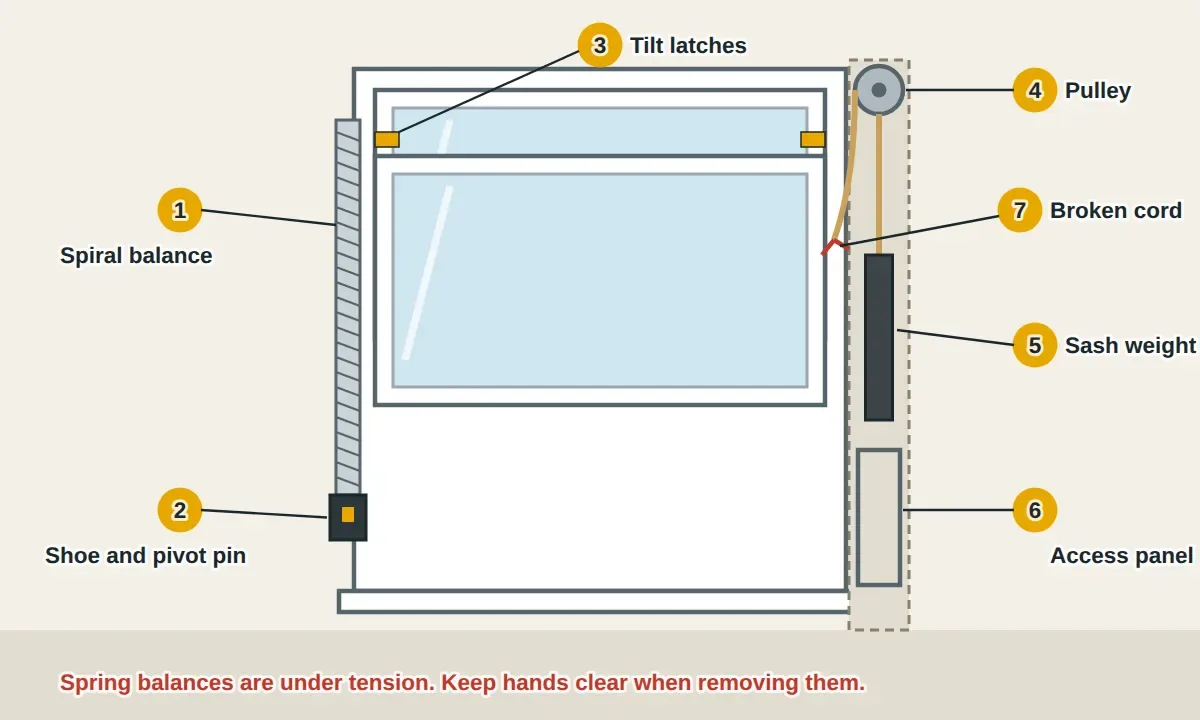
How a window stays open
On a double-hung window, the sashes need help to stay up, because their weight wants to pull them down. Newer windows use spring balances in the side jambs: a tube balance with a spiral rod inside, a channel balance with a spring or a block-and-tackle pulley, or a flat coiled-spring balance that unrolls like a tape measure. On tilt-in windows, the balance connects to a shoe that the sash's pivot pin sits in.
Older wood windows use a cotton or nylon cord over a pulley at the top of each side, tied to an iron weight that hangs inside a hidden pocket in the frame. When a cord breaks, the weight drops and that side stops holding. The parts that wear out are inexpensive, but they have to match your window, so identifying the type comes first.
Why windows won't stay up
The shoe dropped and lost the pivot pin.
They no longer pull hard enough.
The weight fell inside the frame.
A balance rated for a lighter sash.
| You notice | Likely cause | Start at |
|---|---|---|
| Not sure what kind of window | Several balance types | Step 1 |
| Sash tilts or sags on one side | Shoe unhooked | Step 2 |
| Slides down slowly on its own | Worn spring balances | Step 4 |
| Springs up too fast | Too much tension | Step 6 |
| Old wood window, one side slams | Broken sash cord | Step 7 |
Let's fix it
- Find out what holds the sash upRaise the bottom sash and look in the side tracks. A round tube is a spiral balance, a flat metal or vinyl channel is a channel or block-and-tackle balance, and a flat steel ribbon coming out of a housing near the top is a coil spring balance. If you see a cord running over a pulley near the top of the frame, the window has sash weights. Look on the balance for a label with a code or length, and write it down.

- Check for a balance that came unhookedOn tilt-in windows, the sash's pivot pins sit in shoes that slide in the tracks. If a shoe has dropped or unhooked, the sash will sag on that side. Tilt the sash in, turn the shoe's cam with a flathead screwdriver to unlock it, slide it into line with the shoe on the other side, turn it back to lock it, and set the pivot pin back in it. Many windows fix that way in a few minutes.

- Take out the sashUnlock the window and raise the bottom sash a few inches. Slide the tilt latches on top of the sash toward the center and tilt it toward you. Lift one side up to free its pivot pin from the shoe, then the other, and set the sash on a padded surface. Have a helper hold it; double-pane sashes are heavier than they look.

- Order matching balancesMatch the replacement by the code on the old balance if there is one; otherwise measure the balance length, note its type, and check the window brand, often printed on the glass spacer or a jamb label. Replace balances in pairs so both sides pull evenly.

- Replace a spring balanceSpring balances are under tension, so keep your hands clear and follow the part's instructions. Remove the screw at the top of the old balance and lift it out of the track, unhooking it from the shoe. Set the new one in place, screw it at the top, and connect it to the shoe. A spiral balance usually needs a set number of turns with the tension tool before it's hooked to the shoe; the package lists how many.

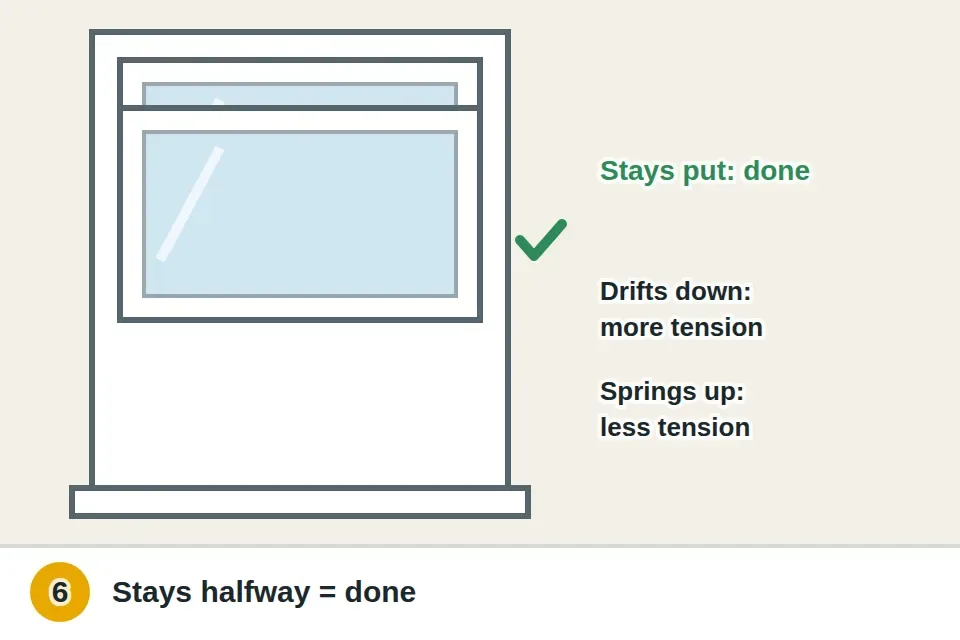
- Put the sash back and test itSet both pivot pins into the shoes, tilt the sash up into the tracks, and slide the tilt latches into place. Raise it halfway and let go. It should stay put; if it drifts down, the balances need more tension or a heavier-rated balance. If it springs up, there's too much tension.
- Restring a broken sash cordOn an older wood window, pry off the thin stop molding on the side with the broken cord, working from the middle, and lift out the bottom sash. Unscrew or pry open the small access panel low in the side of the frame and pull the weight out. Thread new sash cord over the pulley and down to the access hole, tie it to the weight, and set its length so the weight hangs a few inches above the bottom of the pocket when the sash is all the way up. Nail or knot the other end into the groove in the side of the sash. If the upper sash cord is broken, the parting bead between the sashes has to come out too.
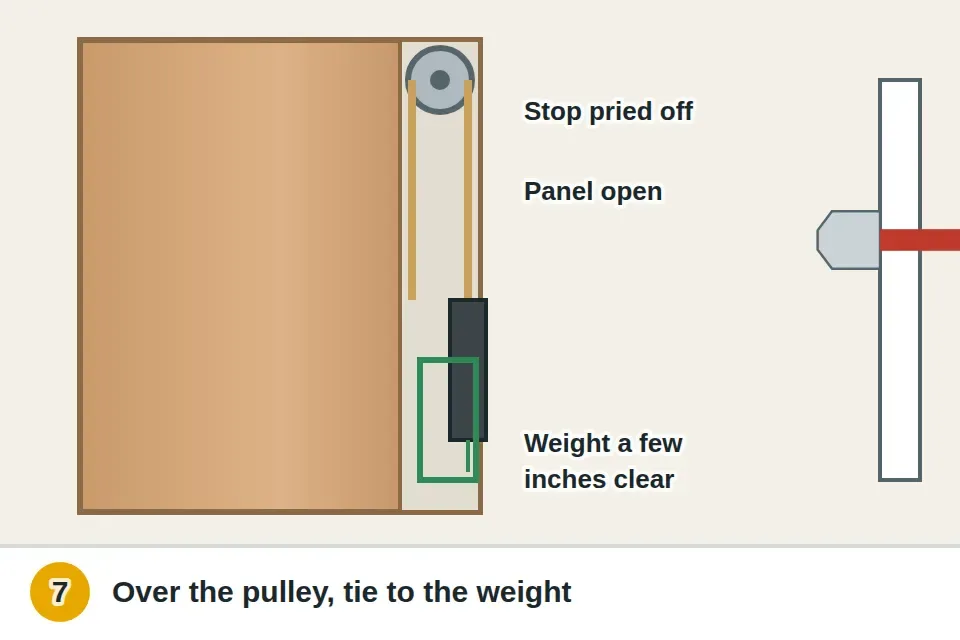
- Reinstall the stop and finishSet the sash back in, close the access panel, and nail the stop molding back with finish nails, leaving a small gap so the sash slides freely. Set the nails, fill the holes, and touch up the paint. Test the window through its full travel.

Watch it done
- The sash stays put halfway up
- It slides smoothly both ways
- Both sides rise evenly
If it's a different window problem
If the window sticks instead of sliding down, check our guide for a window that sticks or won't open.
If cold air comes in around the window, there's a separate guide for a drafty window.
What a pro typically charges (a rough estimate; prices vary by area): A window repair service typically charges $150–$300 to replace the balances in one double-hung window and $150–$350 per window to restring sash cords on older wood windows.
Find a handyman near youSomething else going on?
Window won't stay open questions
Why won't my window stay open?
Its balances have come unhooked or worn out, or on an older wood window, a sash cord has broken.
Can I replace window balances myself?
Usually, yes, with the right matching parts and a helper to hold the sash.
How do I know which window balance I need?
Look for a code or length on the old balance, note its type, and match it. Replace them in pairs.
How do I fix a broken sash cord?
Remove the stop molding and sash, pull the weight out through the access panel, and tie on new sash cord.
Why does my window slide down?
The balance that holds the sash up has come loose or worn out. A loose balance can be clipped back in minutes, and a worn one replaced.