Refrigerator freezing food
When a refrigerator freezes lettuce, milk or leftovers, it's usually getting too much cold air, or the cold air is landing in one spot. A thermostat set too low and food pushed against the vent where freezer air comes in are common causes, and both cost nothing to fix. If the whole fridge stays below freezing at a normal setting, the air damper or the temperature sensor that controls it may be stuck or failing. Those parts are replaceable, often without a service call.


How a refrigerator keeps food cold without freezing it
In most refrigerators, only the freezer has a cooling coil. A fan blows cold freezer air through an opening into the fresh food section, and an air damper, a small motorized or spring-loaded door in that opening, controls how much comes through. A temperature sensor (a thermistor) or a mechanical thermostat in the fridge section tells the damper to open when it's warm and close when it's cold enough. That cold air enters through a vent, usually at the back of the top shelf or along the back wall, and spreads out from there.
So food freezes in a fridge for two main reasons. Either too much cold air is coming in overall, because the setting is too low, the damper is stuck open or the sensor reads wrong, or the air isn't spreading out, because food is sitting right in front of the vent and getting a direct blast of air that's below freezing. A fridge in a cold garage has a third problem: the room is so cold that the fridge section never calls for cooling the way it should, and some models behave oddly until the room warms up.
Why a fridge freezes food
The control is set to its coldest, or reset after an outage.
Items against the vent get a blast of freezer air.
Freezer air pours into the fridge nonstop.
The control thinks the fridge is warm and keeps cooling.
Low room temperatures throw off the fridge's controls.
Little food to hold the cold, so temperatures swing.
| You notice | Likely cause | Start at |
|---|---|---|
| Not sure how cold it actually is | Check with a thermometer | Step 1 |
| Everything is frozen or icy | Setting too low | Step 2 |
| Only food near the vent freezes | Airflow blocked | Step 3 |
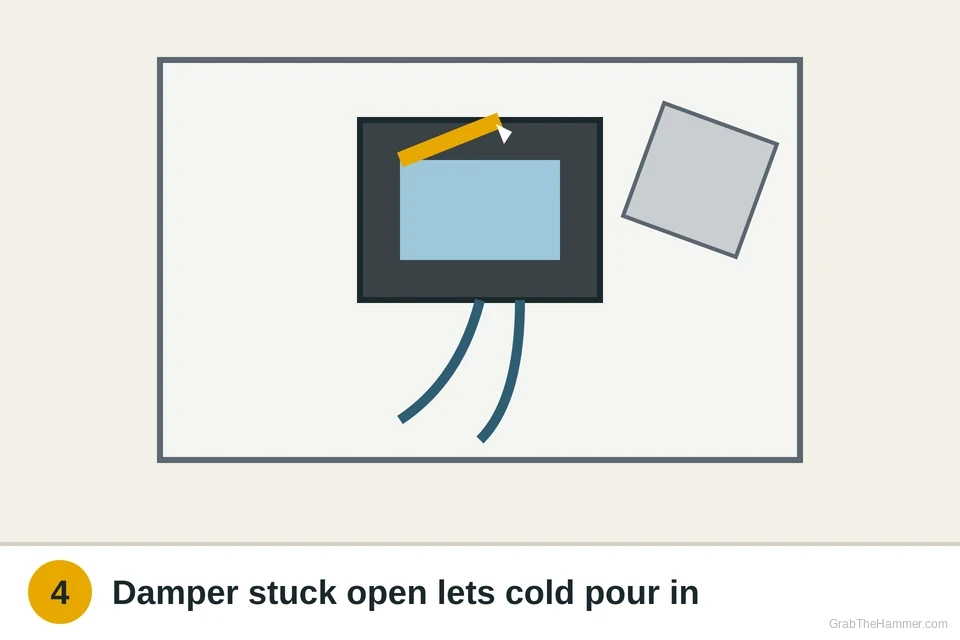
| Too cold at a normal setting | Damper stuck open | Step 4 |
| Temperatures swing or controls act up | Sensor or control | Step 5 |
| Fridge is in a garage or cold room | Room too cold | Step 6 |
Let's fix it
- Measure the real temperatureThe dial or display number doesn't tell you the actual temperature. Put an appliance thermometer in a glass of water on the middle shelf, close the door, and read it after 24 hours without adjusting anything; water gives a steadier reading than air. The FDA recommends keeping the fridge at or below 40°F and the freezer at 0°F, and most people find 37°F to 38°F keeps food fresh without freezing. Also put a second thermometer near the spot where food froze. If the middle reads 37°F but the back of the top shelf reads 28°F, it's an airflow problem near the vent.

- Set the controls correctlyOn a dial, the numbers usually mean colder as they go up, so 1 is warmest and 5 or 7 is coldest; a middle setting is a good start. On a digital display, set the fridge to 37°F to 38°F and the freezer to 0°F. On models with two dials, one may control the freezer and one the airflow to the fridge, so check the label or manual before turning both. Also look for a Quick Cool, Power Cool or Turbo setting, which can be left on by accident and drives the temperature down; turn it off. After a power outage, some digital controls return to default settings, so recheck them. Make one change, then wait 24 hours and recheck the thermometer.

- Move food away from the ventFind the cold air vent in the fridge section: usually a grille at the back of the top shelf, along the back wall, or in a column on the side. Hold your hand in front of it with the door open; you'll feel cold air when the fan is running. Move food at least a couple of inches away from it, and keep delicate items like lettuce, berries, eggs and milk out of that area. Don't let bags or containers press against the vent, which can block it and also send the cold air straight into whatever is in front of it. Also leave space between items so air can circulate; a packed fridge can trap cold air in pockets.

- Check the air damperThe damper is usually behind a cover near where the vent enters the fridge, often at the top back or inside the control housing. With the fridge unplugged, remove the cover screws or clips as your manual shows and look at the damper door. On many models you can see whether it's open or closed; some have a small foam-sealed flap. If it's stuck open, frozen open with ice, or the foam seal is torn, freezer air flows in nonstop. A damper frozen open can be thawed by leaving the fridge unplugged with the doors open and towels below for several hours. A broken or motorized damper that won't move is replaced as an assembly, typically $30 to $80 for the part, ordered by model number.
- Check the temperature sensor and controlsMost newer refrigerators use a thermistor, a small sensor clipped near the vent or behind a panel in the fridge section, wired to the control board. If it fails, drifts or comes loose, the control can get a wrong reading and keep the damper open. Make sure nothing is stacked against the sensor's spot and that it's clipped where it belongs. Many models have a diagnostic mode, described in the tech sheet behind the kick plate or on the back, that shows sensor errors. A thermistor typically costs $10 to $40 and is tested with a multimeter against a resistance chart. On older models with a dial, a stuck thermostat or damper control assembly does the same job and is replaced as one part.

- Watch for a cold room or garageMany standard refrigerators are designed for rooms between about 50°F and 90°F; check your manual for its range. In a garage or porch that drops below that in winter, the fridge section can freeze food, or the freezer can warm up, because the controls rely on the room being warmer than the fridge. If your fridge lives in a garage, look for a model rated for garage use, a garage kit or heater the manufacturer offers for some models, or move it indoors for the cold months. Check the freezer with a thermometer too, since it can warm enough to thaw food. A nearly empty fridge also swings more in temperature; a few jugs of water on the shelves help it hold steady.

Watch it done
- The thermometer in water reads 37°F to 40°F
- Lettuce, milk and eggs stay unfrozen, even near the back
- The freezer stays around 0°F
Still freezing at a normal setting? A tech can test the damper and board.
If it comes back
If food freezes again after a few weeks, check whether something has crept back in front of the vent, and recheck the setting; kids and guests turn dials. If the fridge is fine but the freezer is building frost, see the guide for frost buildup in the freezer.
If the fridge swings the other way and gets warm, the same damper or a frosted coil can be the cause. See the guide for a refrigerator that isn't cooling.
If the doors don't close tightly, warm air gets in and the fridge works harder, which can cause uneven temperatures. See the guide for a refrigerator door that won't seal.
What a pro typically charges (a rough estimate; prices vary by area): A service call typically runs about $100–$200, and replacing a damper or sensor usually totals about $150–$350 with the part. A control board costs more.
Find an appliance repair tech near you