Heating & cooling

Fireplace smoking into the room

A wood fireplace that pushes smoke into the room usually has an airflow problem, not a broken part. The damper may be closed or only partly open, the flue may be too cold to pull, or the house itself may be pulling air down the chimney. Wet wood and fires built too big or too far forward make it worse. If smoke is filling the room right now, deal with that first.

Hand pushing a fireplace damper fully open with a rod while a small wood fire burns at the back of a brick firebox and smoke curls at the opening
Check the damper first: a partly closed damper is a common reason smoke spills into the room.
Quick answerIf smoke is pouring in, stop adding wood, open windows and let the fire burn down. Then check that the damper handle is all the way open. Next time, warm the flue by holding a lit roll of newspaper up near the damper for a minute before lighting. Turn off kitchen and bath fans and the clothes dryer, and crack a window near the fireplace. Burn dry, split wood in a small fire at the back of the firebox. If it still smokes, have a certified chimney sweep check for a blockage.
Worth checking firstShine a flashlight up past the damper before you light anything. You should see the damper plate standing open and, in many chimneys, a little daylight or a dark open flue. Debris, leaves, a nest or black flaky crust are signs to stop and call a sweep.
Easy15 min–1 hr$0–$40
Side cutaway of a wood fireplace and masonry chimney showing the open damper at the top of the firebox, the flue rising to a chimney cap, a small fire on a grate at the back, smoke spilling into the room, and a window cracked open to let air in
The damper (1) must be fully open. Smoke rises up the flue (2) and out through the chimney cap (3), which can clog. Build a small fire at the back of the firebox (4). A window cracked open (5) gives the house the air it needs.

How a fireplace pulls smoke up the chimney

A working chimney pulls because hot gas is lighter than the cool air around it. When the flue is warm, the rising smoke creates a gentle suction at the fireplace opening, called draft. Room air flows into the firebox, feeds the fire and carries the smoke up past the open damper, through the flue and out the top. The damper is a metal plate at the top of the firebox that closes the chimney when you aren't burning. A cap on top keeps out rain, animals and leaves.

Anything that weakens that pull lets smoke roll out of the opening instead. A closed or half-open damper chokes the path. A cold flue holds a column of heavy air that pushes down until it warms up. Exhaust fans, a clothes dryer, a furnace and a tight, well-sealed house can all pull air out faster than it comes in, so the house sucks air down the chimney. Wet wood makes more smoke and less heat. A blockage, like creosote buildup, a nest or a clogged cap screen, narrows the flue. Some fireplaces also have an opening that's large for the chimney, so they smoke a little even when everything else is right.

Why the fireplace smokes

Damper closed or partly open

The smoke has nowhere to go but the room.

Cold flue

Heavy cold air in the chimney pushes smoke back down.

House pulling air

Fans, a dryer or a tight house draw air down the chimney.

Wet or green wood

Smolders and makes lots of smoke with little heat.

Fire too big or too far forward

Smoke escapes past the top of the opening.

Blocked or undersized chimney

Creosote, a nest, a clogged cap, or a short chimney.

What's happening?
You noticeLikely causeStart at
Smokes right as you light itDamper not fully openStep 1
Smokes at first, then clearsCold flueStep 2
Worse with fans or dryer runningHouse pulling airStep 3
Fire hisses and smoldersWet wood or poor fire buildStep 4
Worked fine, now suddenly smokesBlockage in the flue or capStep 5
Small puffs at the top of the openingDraft or opening size problemStep 6
Smoke and carbon monoxide are dangerousIf smoke fills the room, stop adding wood, open windows and doors, and let the fire burn down. Don't throw water into a hot firebox; the steam can burn you and crack the masonry. If fire spreads outside the firebox, or you hear a roar and see flames or sparks from the chimney top, get everyone out and call 911. A smoky fireplace can also spill carbon monoxide, which you can't smell. Make sure you have working smoke alarms and a carbon monoxide alarm near sleeping areas. Don't climb a ladder onto the roof; leave chimney work to a certified sweep.

Let's fix it

0 of 6 done
  1. Check that the damper is fully openDo this with the fire out and the firebox cool. Find the damper control. It's usually a lever, a handle or a rotary knob just inside the top of the opening. Some chimneys have a top-sealing damper instead, worked by a chain or cable that hangs down in the firebox. Push the lever all the way to open, or pull the chain until it hooks. Then shine a flashlight up. The damper plate should stand open, and you should see a dark, open flue. If the damper only opens part way, or won't move, stop and don't light a fire. A rusted or broken damper is a job for a sweep.
    Something went wrong?
    • The handle moves but the plate stays shut The linkage may be loose or broken. Don't light a fire until a chimney sweep repairs or replaces the damper.
    Hand pushing a damper lever open inside the top of a fireplace opening, with a flashlight showing the damper plate standing open
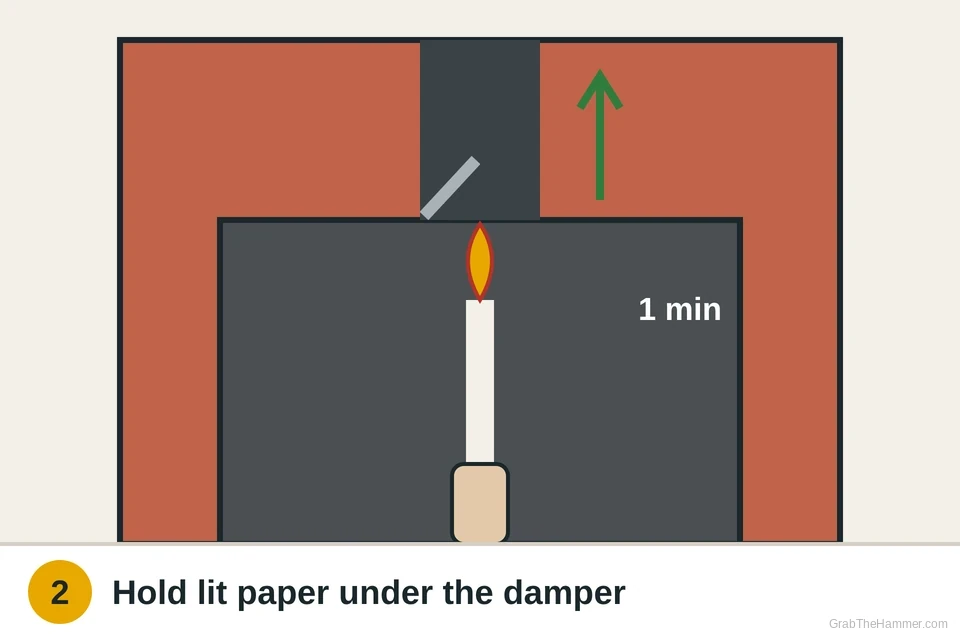
  2. Warm a cold flue before lightingA cold chimney is full of heavy, cool air that pushes smoke back into the room. This often happens on the first fire of the day, and with chimneys on an outside wall. With the damper open, roll two or three sheets of newspaper into a loose tube. Light the top end and hold it up inside the firebox, over the grate and just under the damper, for about a minute. Keep your hand and sleeve below the flame. You'll feel the air start to pull upward and see the flame lean toward the flue. Drop the paper onto the grate and light the fire right away while the draft is going. If the smoke never lifts, skip to Step 3.
    Something went wrong?
    • The paper flame pushes back toward you The house is likely pulling air down the chimney. Crack a nearby window, then try again. If that helps, Step 3 is your fix.
    Hand holding a lit roll of newspaper up under the open damper, with an arrow showing smoke being drawn up the flue
  3. Stop the house from pulling air downTurn off the kitchen range hood, bathroom fans and the clothes dryer while the fire burns. Then open a window an inch or two in the same room, as close to the fireplace as you can. Light a stick of incense or blow out a match and hold it at the top edge of the opening. Smoke that drifts into the fireplace means good draft. Smoke that drifts into the room means the house is pulling air. If cracking the window fixes it, your home is too tight for the fireplace to get enough air. That's common in newer or recently sealed homes, and it isn't your fault.
    Something went wrong?
    • Still smokes with every fan off and a window open Check the furnace closet and any basement doors; a furnace or water heater can pull air too. If nothing changes, the problem is likely in the chimney, so go to Step 5.
    Window cracked open beside a fireplace with an arrow of fresh air flowing in, and a crossed-out bathroom exhaust fan
  4. Burn dry wood in a small fire at the backWet or green wood smolders, hisses and makes far more smoke. The EPA advises burning wood with moisture below 20 percent. A firewood moisture meter costs about $20 to $40. Split a log and press the pins into the fresh inside face; readings under 20 are dry enough. Dry wood is usually lighter, with cracked ends and a hollow knock. Store it outside, not in the house. Build a small fire on the grate, pushed toward the back wall of the firebox, with small kindling under a few split pieces. Big fires near the front spill smoke past the top of the opening. Never use gasoline, lighter fluid or trash to get it going.
    Something went wrong?
    • Your wood reads over 20 percent Stack it off the ground, split, with the top covered and the sides open, and let it dry longer. Wood typically needs six months or more. Buy kiln-dried wood for now.
    Moisture meter pins pressed into the freshly split face of a log reading 18 percent, next to a small fire built at the back of the firebox
  5. Look for a blockage from belowIf the fireplace drew fine before and suddenly smokes, something may be in the flue. With the fire out and the ashes cold, put on safety glasses. Open the damper and shine a bright flashlight up from inside the firebox. Look for leaves, twigs, a nest, fallen bricks, or a thick black crust or shiny glaze on the walls. That crust is creosote, and it can catch fire. A mesh cap screen on top can also clog with soot, which you may see as a dark patch at the top. Don't poke at a nest; some birds are protected. If you see any of this, stop. Don't burn again until a sweep clears it.
    Something went wrong?
    • You hear scratching or chirping An animal is likely in the chimney. Keep the damper closed and call a sweep or wildlife service. Don't light a fire to drive it out.
    Flashlight beam shining up a chimney flue from the firebox, showing a bird nest and black creosote crust partly blocking it
  6. Call a certified sweep for blockages and draftBook a chimney sweep certified by the Chimney Safety Institute of America (CSIA) if you saw a blockage, if the damper is stuck, or if it smokes after Steps 1 to 4. Don't go on the roof yourself. The sweep can clean creosote, remove nests, clear or replace the cap, and check the flue liner. NFPA 211, the national chimney standard, calls for an inspection at least once a year. If the chimney is clean but still smokes a little, ask about draft fixes. A metal smoke guard across the top of the opening, a taller flue, or a different cap can help. Gas fireplaces are a different system, so have a gas fireplace technician check those.
    Something went wrong?
    • The sweep says the chimney is too short or the opening too big That's a design issue, not a cleaning one. Ask for options and a written quote, and keep the window cracked until it's fixed.
    Chimney sweep with a brush and rod cleaning a fireplace flue, with a metal smoke guard strip mounted across the top of the fireplace opening

Watch it done

Why Does My Fireplace Smoke Back Into My Home?By NorthlineExpress on YouTube. Their method may vary a little from ours.
Watch on YouTube
How you'll know it's fixed
  • Smoke rises straight up into the flue from the moment the fire catches
  • Incense smoke at the top of the opening drifts into the fireplace
  • The fire burns bright with little smoke and no hissing
  • The room doesn't smell smoky after the fire

Still smoking with the damper open, fans off and dry wood? Stop burning and have a certified sweep inspect the chimney.

If it comes back

If the smoking returns partway through the season, creosote or soot may be building up, or the cap screen may be clogging. Have the chimney swept, and burn only dry wood so it builds up more slowly.

If it only smokes on cold, windy days or when the furnace runs, the house is pulling air. Keep a window cracked near the fireplace, and see how to stop drafts around windows for sealing the rest of the house without starving the fire.

If your carbon monoxide alarm sounds while the fire burns, get everyone outside, call 911 or the fire department, and read what to do when a carbon monoxide alarm beeps. If a smoke alarm keeps going off from a little fireplace smoke, see the guide for a smoke alarm going off, but don't disable it.

Test the draft before every fireHold a lit match or incense at the top of the opening after you open the damper. If the smoke pulls in, light up. If it drifts out, warm the flue or crack a window first.
Renting?You can open the damper, crack a window and burn dry wood. Tell your landlord if it still smokes, the damper is stuck, or you see debris in the flue, and don't use it until it's checked.
Call a chimney sweep ifYou see a blockage, nest, loose bricks or heavy creosote, the damper is stuck or broken, the fireplace smokes even with fans off and dry wood, or it hasn't been inspected in over a year. Stop using the fireplace until it's checked.Fix it yourself or call? Compare the cost →

What a pro typically charges (a rough estimate; prices vary by area): A chimney sweep and basic inspection typically costs about $150–$400. A new chimney cap installed often runs about $150–$500, and a smoke guard about $50–$150 for the part.

Find a certified chimney sweep near you

Something else going on?

Smoky fireplace questions

Why is smoke coming out of my fireplace into the house?

Usually the damper isn't fully open, the flue is cold, the house is pulling air down the chimney, or the wood is wet. A blocked chimney can also cause it.

How do I get my chimney to draw better?

Open the damper fully, warm the flue with lit newspaper before lighting, turn off exhaust fans, crack a nearby window and build a small fire at the back with dry wood.

Does opening a window help a smoky fireplace?

Often, yes. A window cracked an inch or two near the fireplace lets in the air the fire needs, so the house stops pulling air down the chimney.

Is it dangerous if my fireplace smokes?

It can be. Smoke irritates lungs, and a fireplace that doesn't draw can spill carbon monoxide. Keep working smoke and CO alarms, and stop burning if it keeps happening.

How often should a chimney be cleaned?

NFPA 211 calls for an inspection at least once a year. The sweep cleans it when soot or creosote has built up enough to need it.

Reader reports

Did this fix work for you?

Tell the next person how it went. Your numbers are added to the totals anonymously; tips are read by our team before they appear.

How did it go?
Reader Q&A

Questions from readers

No questions on this guide yet. If you're stuck, ask below. Useful questions and answers get added here for the next person.

Ask a question

We read every question before anything is published, and we never show names or emails. Please leave out personal details. PrivacyAccessibility

About the authors

GrabTheHammer Team

  • No sponsored picks
  • Safety first
  • Tells you when to call a pro

We're a small team of writers and editors who check every guide against manufacturer instructions and common code requirements. Our goal is to help you understand the problem, tackle what you safely can and know when to call a pro.

Checked against: Chimney Safety Institute of America (CSIA) homeowner guidance, NFPA 211, and EPA Burn Wise best wood-burning practices.

How we write and review →
A helpful next stepCarbon monoxide alarm beeping? What it meansMake sure your CO alarm works before the next fire.