Fix loose or baggy carpet on indoor stairs
Loose stair carpet is a trip hazard, so fix it soon and keep people off that step until you do. Most of the time the carpet has slipped off the tack strip in the crease at the back of the tread. You can often re-tuck it with pliers, a carpet stair tool and a hammer. If the stair itself moves under the carpet, stop and fix the stair.


How carpet stays tight on a stair
On most carpeted stairs, a narrow wood tack strip is nailed across the back of each tread, near the riser. Its pins point up and lean toward the riser. The carpet is stretched over the tread and pressed onto those pins. The edge is then pushed down into the small gap between the strip and the riser, so the pins and the crease both hold it. Staples under the nose often help it hug the edge.
Every footstep pushes the carpet forward and down. Over years, that can pull the carpet off the pins, flatten the pins, or loosen the staples under the nose. The carpet then rises out of the crease or sags over the edge. That slack is what catches a toe. It is common wear, not your fault.
Why stair carpet comes loose
The carpet lifts at the back of the tread but the pins under it still feel sharp.
The strip feels smooth, a piece is missing, or it is split or rotted.
The carpet sags or bags over the front edge of the step.
The tread moves, creaks or rocks when you step on it, even with the carpet tight.
You see a rip, a bald spot or the backing showing at the nose.
Several steps are baggy at once, often on an older carpet.
| You notice | Likely cause | Start at |
|---|---|---|
| Not sure what's loose | Block the stairs and press each tread | Step 1 |
| Carpet out of the crease | Pull the loose section free with pliers | Step 2 |
| Pins flat, split or missing | Nail in a new tack strip | Step 3 |
| Strip is good, carpet is slack | Stretch it and tuck it with a stair tool | Step 4 |
| Baggy over the nose | Staple under the nose | Step 5 |
| Tucked in, loose yarn left | Trim, test and protect the step | Step 6 |
Let's fix it
- Block the stairs and find what's loosePut a gate or a sign at the top and bottom, and tell everyone the stairs are closed. Put on safety glasses, work gloves and knee pads. Start at the loose step and press down hard near the nose, then at the back near the riser. If the wood moves, rocks or creaks, stop here. The stair is loose, and you should fix it first with our squeaky stairs guide. If only the carpet moves, look closely. Carpet lifting at the back of the tread is usually off the tack strip. A sag over the front edge points to the nose. A rip or bald spot needs a patch or a pro. Check the 2 steps above and below too, since loose carpet often spreads.

- Pull the loose section free with pliersIf the carpet is loose in the crease, free the slack area so you can reset it. Grip the carpet edge right at the crease with a pair of pliers, or a carpet stretcher grip if you have one. Pull it up and toward you, away from the riser, so it comes off the tack strip pins. Work only across the loose section. Leave tight carpet on either side alone. If staples on the riser hold the carpet down, pry them out with a flat screwdriver and pliers. Fold the carpet back just far enough to see the full tack strip. Don't pull it so hard that the backing tears. If it rips or the yarn unravels as you pull, stop and plan a patch instead.

- Check the tack strip and replace it if neededRun a gloved finger lightly over the strip. Good pins feel sharp and stand up, leaning toward the riser. If they are sharp and the strip is solid, skip to step 4. If the pins are flat, missing, or the wood is split or loose, replace that piece. Pry the old strip up with a flat pry bar, working from the ends. Cut a new strip to length with tin snips or a saw. Set it with the pins angled toward the riser. Leave a small gap to the riser, usually a bit less than the carpet is thick; check the strip package. Drive its nails with controlled hammer taps, one near each end. If the strip splits, move the nail over.

- Stretch the carpet and tuck it with a stair toolLay the carpet back over the tread. Pull it toward the riser by hand until the slack is gone, or use a knee kicker set a couple of inches from the riser. Don't use a power stretcher on a stair; it is built for whole rooms and can tear the carpet on a short stair run. Press the carpet onto the pins so they grab it. Now set a carpet stair tool, also called a tucker, in the crease. Strike the tool's head with a hammer or rubber mallet using firm, controlled blows. Move it along the crease every few inches. The carpet should sink into the gap and stay. If it bulges, lift it off the pins and start again.

- Staple a baggy nose underneathIf the carpet sags over the front edge, the nose needs help. Pull the carpet down snug around the nose with one hand. With your other hand, set a staple gun under the nose, where the carpet meets the riser below. Point it straight into the wood. Use staples sized for carpet, often about 9/16 inch, and set them through the carpet, not through loose pad alone. Space them a few inches apart across the step. Part the pile with your fingers before each shot so the staple sinks into the backing and hides under the yarn. Keep your fingers clear of the gun's nose. If staples won't sink, tap each one flat with a hammer.

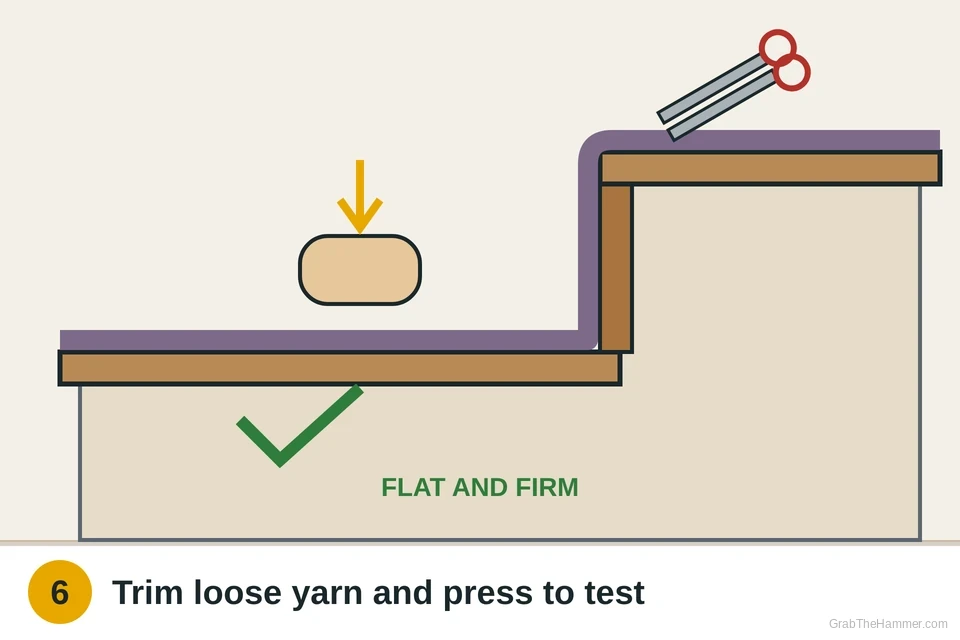
- Trim, test and protect the stepLook across the tread at eye level. The carpet should lie flat, with no ridge at the crease and no gap at the nose. Snip any loose yarn or fuzz flush with sharp scissors. Don't pull a loose loop, since that can run a row. Press firmly at the back and front of the tread. Nothing should lift or slide. Pick up every staple, nail and strip scrap, then run a magnet or a shop vac over the step. Walk up and down slowly while holding the rail. If the carpet still shifts underfoot, repeat step 4 or add staples. Open the stairs only when every step you worked on feels firm.
Watch it done
- The carpet lies flat in the crease with no ridge or bump
- Pressing the nose and back of the tread doesn't lift the carpet
- No staples, pins or loose yarn show on the step
- You can walk the stairs without a toe catching
Still loose after re-tucking? The pins may be worn, so replace the tack strip in step 3.
If it comes back
If the same step loosens again within weeks, the tack strip probably isn't gripping. Replace it. Our hammer guide covers controlled taps that drive tack strip nails without splitting the strip.
If the tread creaks or moves under tight carpet, the problem is the stair, not the carpet. See fixing squeaky stairs. If the carpet at the bottom or top of the stairs meets a room, loose spots there are covered in carpet coming up at the edge.
If carpet in the hallway or rooms is rippling too. Read fixing carpet ripples. For a small hole or a burn on a stair, patching a hole in carpet shows how to set in a matching piece of carpet.
What a pro typically charges (a rough estimate; prices vary by area): A carpet installer typically charges about $100–$250 for a small stair repair, often with a minimum trip charge. Bigger jobs cost more.
Find a carpet installer near you