Walls

Hang a picture on drywall with a hammer and nail hooks

Most light and medium framed pictures hang well on drywall with a hammer and a picture hook. A picture hook is a small metal hook with a thin nail that goes in at an angle, which lets the drywall hold far more than a straight nail would. The package lists a weight rating, so you pick one rated above your frame. Then you mark the height, tap the nail in gently and level the frame. Heavy mirrors and plaster walls need a different method, and we link to those below.

Hands tapping the nail of a brass picture hook into a painted wall with a small hammer, a framed print leaning below
Hold the hook at its built-in angle and use light, controlled taps.
Quick answerWeigh the frame on a bathroom scale. Buy a picture hook rated above that weight, or use two hooks for wide frames. Mark where the hook goes, with the frame center about 57 to 60 inches off the floor. Wear safety glasses and tap the nail in at the hook's angle with light taps. Hang, level and add felt bumpers.
Worth checking firstCheck what your wall is before you start. Tap it with a knuckle. Drywall sounds hollow and a pushpin goes in easily. Old plaster feels hard and cold and can crack, so see hanging things on plaster. If the frame weighs more than your hooks can hold, see hanging a heavy mirror or picture.
Easy15–30 min per picture$3–10 for hooks
Side cutaway of a drywall wall with a picture hook nailed in at a downward angle, a framed picture hanging from its cord on the hook, the frame center marked at about 57 to 60 inches, and a stud and cable shown inside the wall
The picture hook (1) has a thin nail driven at an angle (2) into the drywall. The cord (3) on the back of the frame rests on the hook. Aim the frame center (4) at about 57 to 60 inches. Avoid cables (5) that often run straight up or down from outlets and switches.

How a picture hook holds on drywall

Drywall is a layer of gypsum between two sheets of paper. A plain nail driven straight in holds poorly, because the soft gypsum crumbles around it and the nail can tip out. A picture hook fixes that. Its nail passes through a small sleeve at a steep downward angle. The weight of the frame pulls down on the hook, which presses the nail across the gypsum instead of pulling it straight out. That's why a tiny nail can carry a real load.

Makers rate each hook by weight. OOK and Hillman, for example, sell nail-in hooks in common ratings such as 20, 30 and 50 pounds, printed on the package. The rating assumes the hook is installed the way the instructions show, usually into drywall or wood. The cord, sawtooth or D-ring on the back of the frame also matters. Two hooks spread the load and keep a wide frame from tilting. If you hit a wood stud behind the drywall, the nail holds even better.

What makes a picture fall or hang wrong

Hook rated below the frame weight

The nail bends or pulls through the drywall.

Straight nail with no angle

Soft gypsum lets a plain nail tip out.

Measured to the cord, not the pull

The cord drops when loaded, so the frame hangs low.

One hook on a wide frame

The frame tilts when someone walks by.

Weak or old hanging cord

A frayed or loose cord can slip or snap.

Plaster or crumbly wall

Plaster can crack around a hammered nail.

What's happening?
You noticeLikely causeStart at
Not sure which hook to buyWeigh it; pick a higher ratingStep 1
Don't know how highMark center at 57 to 60 inchesStep 2
Near an outlet or switchScan and move the spotStep 3
Ready to installTap in at the hook's angleStep 4
Picture tilts or slidesLevel it; add bumpersStep 5
Hole in the wrong placeFill with spackleStep 6
Protect your eyes, mind hidden pipes and cables, and know the weightWear safety glasses when you hammer. A nail can glance off or a chip of drywall can fly. Hidden electrical cables often run straight up or down from outlets and switches, so don't nail directly above or below them. Pipes can run near sinks, toilets and outside walls. Weigh the frame and use hooks rated above it. Glass frames can shatter if they fall, so keep kids and pets clear while you work. If you're on a step stool, keep both feet on it and don't lean past the sides.

Let's fix it

0 of 6 done
  1. Weigh it, check the back and pick the hookStep on a bathroom scale holding the frame, then subtract your own weight. Or weigh it on a kitchen scale if it's small. Turn the frame over and look at the hanger. A sawtooth strip or small ring suits one hook. A cord or two D-rings works with one or two hooks. Tug the cord; if it's frayed, loose at a screw eye or thin, replace it before hanging. Buy a picture hook whose package rating is above the frame weight. For frames wider than about 2 feet, use two hooks spaced apart, so the frame stays level. Stop if the frame weighs more than your hooks are rated for; use anchors or a stud instead.
    Something went wrong?
    • The frame has no hanger at all Add a sawtooth hanger or two D-rings with a cord. Kits are cheap at hardware stores. Center them so the frame hangs straight.
    Back of a framed picture lying face down with a cord across two D-rings, a bathroom scale beside it, and a picture hook package showing a weight rating
  2. Choose the height and measure the cord dropMany galleries and framers hang art so its center sits about 57 to 60 inches off the floor, near average eye level. Over a sofa or table, leave roughly 6 to 10 inches between the furniture and the frame bottom instead. Mark the center height lightly in pencil. Now find the hook spot. Hook a finger under the cord and pull it up tight toward the top of the frame, as a hook would. Measure from the taut cord down to the top edge of the frame. Add half the frame height, then subtract that cord drop. Mark the hook spot that distance above the center mark. A strip of painter's tape on the wall takes pencil and peels off cleanly.
    Something went wrong?
    • My math keeps coming out wrong Try the tape trick. Put painter's tape across the back where the cord peaks, mark the peak, then stick the tape on the wall at your chosen spot and nail through the mark.
    Tape measure from the floor up to a pencil mark at 57 inches on a wall, with a finger pulling a frame's cord taut and a short measurement from the cord peak to the frame top
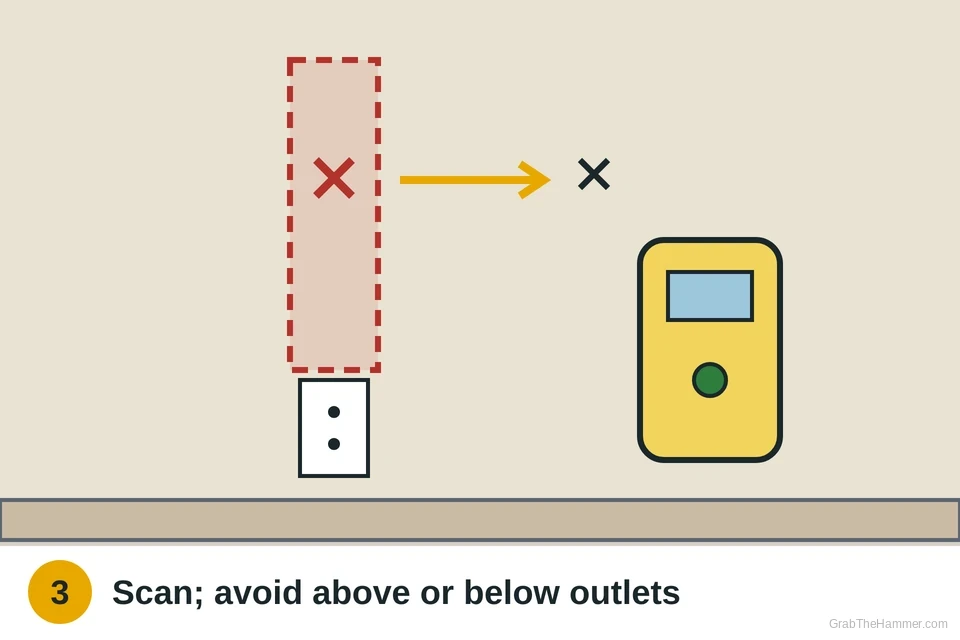
  3. Check for pipes and cables behind the spotLook at what's near your mark. Electrical cables often run straight up or down from outlets and switches, so don't nail directly above or below one. Shift the spot a few inches sideways instead. Pipes often sit behind sinks, toilets and tubs, and on the wall beside them. Scan the area with a stud finder that has an AC or live-wire detection mode, if you have one. It may also show a stud, which holds a nail very well. Picture-hook nails are short, but some can pass through 1/2-inch drywall, so check first. If a nail ever hits a cable, turn that circuit's breaker off and call an electrician. Stop if the scanner flags live current at your mark; move the spot rather than guess.
    Something went wrong?
    • The stud finder beeps everywhere Recalibrate it on a bare spot, hold it flat and move slowly. Paint, damp drywall or metal corner bead can confuse some models. Our guide to finding a wall stud explains other ways to check.
    Stud finder sliding across a wall near a pencil mark, with a red dashed zone running straight up from an outlet and an arrow moving the mark sideways
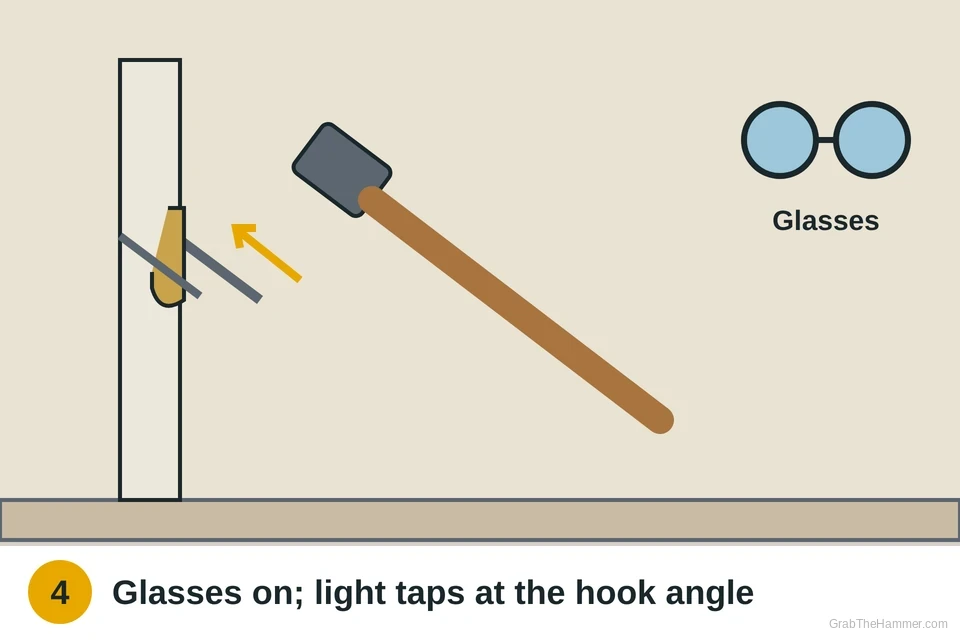
  4. Tap the hook nail in at its anglePut on safety glasses. Use a light claw hammer, about 13 to 16 ounces; see how to use a hammer if you rarely swing one. Hold the hook flat on the wall with its bottom curve on your mark. Push the nail through the sleeve. It will point down at the angle the sleeve sets, so don't straighten it. Pinch the hook with your fingertips and give two or three gentle taps until the nail bites. Then move your fingers away. Tap lightly with the hammer face flat on the nail head until the head stops against the sleeve. Stop there; extra blows crush the drywall and loosen the hook.
    Something went wrong?
    • The nail bent Pull it out with pliers and use a new nail in the same sleeve. Tap more lightly and keep the hammer face square to the head.
    • The hook spins or feels loose The gypsum crumbled. Move up or sideways an inch, or switch to an anchor. A loose hook won't hold its rated weight.
    Fingers pinching a brass picture hook against drywall while a hammer taps the nail head, the nail angled downward through the sleeve, safety glasses shown beside it
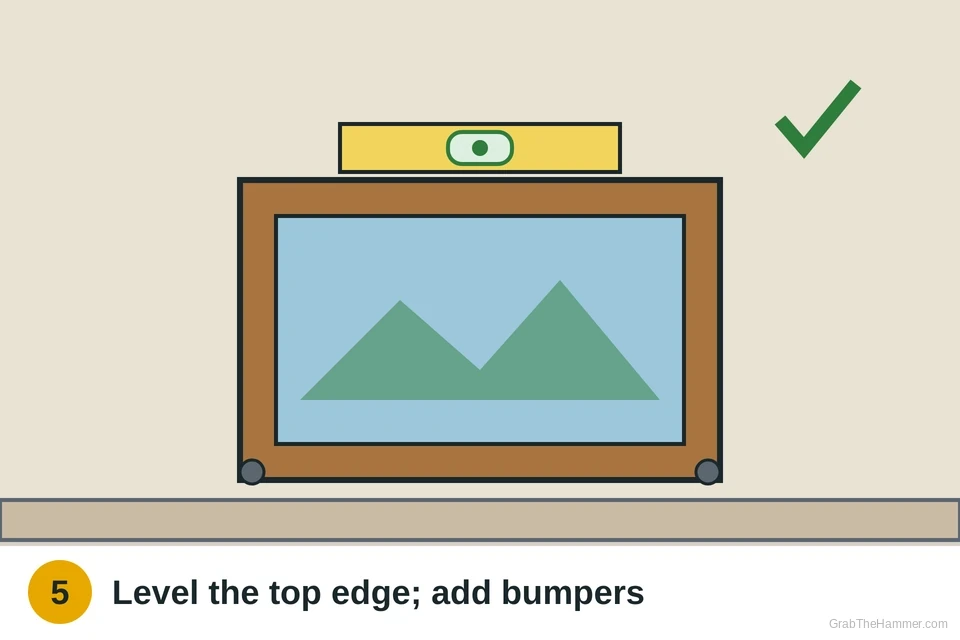
  5. Hang it, level it and add bumpersLift the frame with both hands and lower the cord or sawtooth onto the hook. Let go slowly and watch the hook for a second. It should stay put without sagging. Set a small level or a level app on the top edge. Slide the frame along the cord until the bubble centers. With two hooks, a crooked frame means one hook sits high; take it down and move one hook rather than forcing it. Stick small felt or rubber bumpers on the two bottom corners on the back. They keep the frame from shifting and protect the paint. Step back and look from across the room.
    Something went wrong?
    • It keeps tilting Add a second hook a few inches from the first, or put a bumper on each bottom corner. A dab of removable putty behind a corner can also help.
    Framed picture hanging on a wall with a small level on its top edge showing a centered bubble, and felt bumpers on the lower back corners
  6. Fix a hole in the wrong spotMissed the mark? It happens to everyone. Pull the hook nail out with pliers, pulling along the same angle it went in. Press a little lightweight spackle into the hole with a putty knife or your fingertip. Scrape it flush. Let it dry as the tub says; small holes often dry within an hour or so. Sand lightly if needed and dab on matching paint. If the hole is bigger than a nail hole, or the paper tore, see patching a hole in drywall. Then measure again and set the new hook at least an inch away from the old hole, so the nail bites solid gypsum.
    Putty knife pressing white spackle into a small nail hole in drywall beside a hook that has been moved over, with an arrow showing the knife scraping flush

Watch it done

How To Install A Picture Hook Easily-Full TutorialBy Helpful DIY on YouTube. Their method may vary a little from ours.
Watch on YouTube
How you'll know it's fixed
  • The hook sits tight against the wall and doesn't wiggle
  • The frame hangs level and doesn't slide when nudged
  • The center sits near eye level, or a hand width above furniture
  • No cracks or crumbling around the nail

Hook still loose? Move it an inch, or switch to a drywall anchor or a stud.

If it slips or falls later

If the hook pulls down or the drywall crumbles over time, the frame is likely too heavy for a nail hook. Use the methods in hanging a heavy mirror or picture, which cover anchors and studs.

If the wall cracked around the nail, it may be plaster, not drywall. See hanging things on plaster before you try again, and patching plaster for the damage.

If you ended up with several stray holes, fill them all at once. See patching drywall for larger damage, then paint so the repair disappears.

Pull the cord taut before you measureThe cord sags when the frame lies flat, but it pulls up into a peak when it hangs. Measuring from the taut peak to the frame top is what makes the picture land at the height you marked.
Renting?Many leases allow small nail holes for pictures, but check yours. Picture hooks leave tiny holes that fill easily with spackle when you move out. Ask before using large anchors.
Call a handyman ifThe piece is very heavy, large or valuable, you need to mount into masonry or tile, you're hanging a big gallery wall, or the wall is old plaster that keeps cracking. Stop if the wall sounds hollow and crumbles and the frame is heavy.Fix it yourself or call? Compare the cost →

What a pro typically charges (a rough estimate; prices vary by area): A handyman typically charges about $60–$150 for a short visit to hang several pictures, plus hardware.

Find a handyman near you

Something else going on?

Picture hanging questions

How high should you hang a picture?

A common gallery guideline puts the center about 57 to 60 inches off the floor. Over furniture, leave roughly 6 to 10 inches above it instead.

Can you hang a picture on drywall without a stud?

Yes, for light and medium frames. A picture hook's angled nail holds in drywall up to the rating on its package. Heavier pieces need anchors or a stud.

How much weight can a picture hook hold in drywall?

It depends on the hook. Common nail-in hooks are rated from about 20 to 50 pounds. Read the package and pick one above your frame's weight.

Should I use one nail or two to hang a picture?

One hook works for small frames. Two hooks spaced apart keep wide frames level and share the weight.

How do you hang a picture with a cord on the back?

Pull the cord taut to its peak, measure down to the frame top, and set the hook that far above where the frame top should be. Then level the frame on the hook.

Reader reports

Did this fix work for you?

Tell the next person how it went. Your numbers are added to the totals anonymously; tips are read by our team before they appear.

How did it go?
Reader Q&A

Questions from readers

No questions on this guide yet. If you're stuck, ask below. Useful questions and answers get added here for the next person.

Ask a question

We read every question before anything is published, and we never show names or emails. Please leave out personal details. PrivacyAccessibility

About the authors

GrabTheHammer Team

  • No sponsored picks
  • Safety first
  • Tells you when to call a pro

We're a small team of writers and editors who check every guide against manufacturer instructions and common code requirements. Our goal is to help you understand the problem, tackle what you safely can and know when to call a pro.

Checked against: OOK and Hillman picture hanger packaging and weight ratings; framing and gallery hanging-height guidance (Framebridge, Apartment Therapy).

How we write and review →
A helpful next stepHang heavy pictures and mirrors safelyHang a heavy mirror or large frame next.