Remove green algae from vinyl siding
That green film on vinyl siding is usually algae, sometimes mixed with mildew, growing on dirt and moisture on the shady side of the house. It sits on the surface of the vinyl, so it comes off with a mild cleaner and a soft brush. The care is in not damaging what's around it: harsh chemicals can hurt plants, and a pressure washer aimed upward can drive water behind the siding. Work in sections, keep everything wet and rinse well.


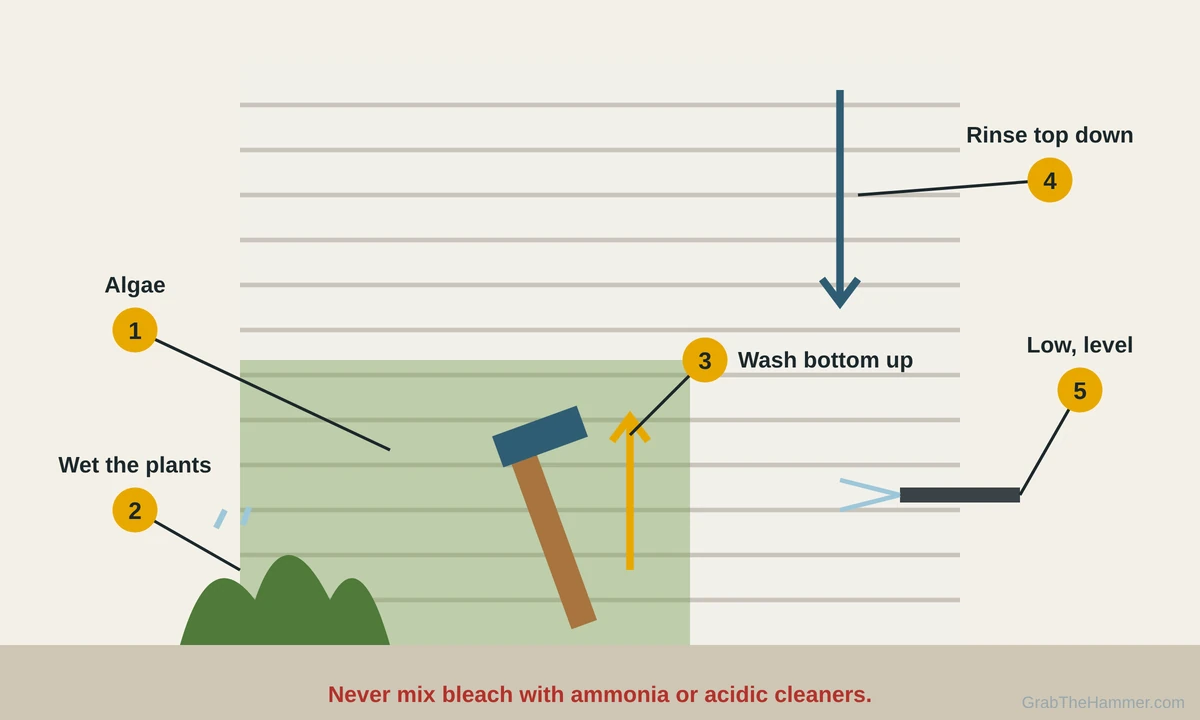
Why vinyl siding turns green
Algae and mildew need moisture, shade and something to feed on. Vinyl itself isn't food, but dust, pollen and pollution settle on it and stay damp on the north side of a house, behind shrubs, under trees and near sprinklers. That's why the green shows up first in those spots and on the lower courses, where splashback keeps things wet. It lives on the surface, in that thin film of grime, not in the vinyl, so the goal is to wash the film away and let the siding dry out.
Vinyl is tough but not invincible. Strong solvents, abrasive pads and very hot water can dull or soften the surface, and a pressure washer aimed upward can force water behind the laps, where it soaks sheathing and insulation. Most siding makers and the Vinyl Siding Institute recommend starting with plain soap and water or a mild solution, using a soft brush, and rinsing thoroughly. For stubborn mildew, VSI gives a stronger mix that includes household bleach, which is safe for vinyl when used as directed, with plants protected and never mixed with ammonia. Plain water and a soft brush handle a lot of light growth on their own, so try the mildest cleaner first and step up only where green remains.
Why algae grows on siding
North-facing walls and spots under trees dry slowly.
Sprinklers, gutters overflowing or plants against the wall.
Pollen and dust give algae something to grow on.
Shrubs pressed against the siding trap damp air.
A yearly rinse keeps growth from getting started.
| You notice | Likely cause | Start at |
|---|---|---|
| Not sure what's safe for your siding | Check the maker's care guide | Step 1 |
| Light green film | Algae on a dirt layer | Step 2 |
| Heavy green or black spots | Mildew or older growth | Step 3 |
| Streaks or spots after washing | Needs a better rinse | Step 4 |
| Siding up high or near the roofline | Ladder or extension pole | Step 5 |
| Green comes back fast in one area | Shade and moisture source | Step 6 |
Let's fix it
- Check what's safe and prep the areaLook up your siding maker's care instructions; they list which cleaners and pressure settings are safe. Close windows and doors, cover outdoor outlets and light fixtures (or turn off their breaker), and move furniture and pots away from the wall. Turn off sprinklers. Thoroughly wet the plants and grass along the wall with a hose, and cover delicate plants with plastic sheeting for no more than an hour or so, since plants can overheat under plastic in the sun. Choose a cool, cloudy day or work on the shady side, so the cleaner doesn't dry on the siding.

- Wash light algae with a mild cleanerFor a light green film, mix a vinyl siding cleaner as its label says, or make a mild solution of 30% white vinegar and 70% water, or a squirt of dish soap in a bucket of warm water. Work in sections about 5 to 10 feet wide. Wet the section with the hose, then apply the cleaner from the bottom up with a soft-bristled, long-handled brush or a garden sprayer. Starting at the bottom keeps cleaner from running down onto dry siding and leaving streaks. Scrub gently along the length of the boards, let it sit for 5 to 10 minutes without letting it dry, and move to Step 4 to rinse.

- Use a stronger mix on heavy growthFor heavy algae or black mildew spots, use a cleaner made for siding mildew, following the label, or a solution recommended for vinyl siding. One commonly cited mix is 1/3 cup powdered laundry detergent, 2/3 cup powdered household cleaner, 1 quart liquid household bleach and 1 gallon of water. Use only detergents that don't contain ammonia. Apply it bottom up as in Step 2, scrub gently, and keep the wall wet. Don't let bleach solutions sit more than a few minutes or dry on the siding, and rinse plants again right after. Test any strong mix on a small hidden spot first, especially on darker-colored siding.

- Rinse from the top downRinse each section well with a garden hose, starting at the top and working down, so dirty water runs over siding you haven't rinsed yet rather than onto clean siding. Keep going until the water runs clear and there's no foam. Rinse the plants and ground below again. If you choose to use a pressure washer, follow the siding maker's guidance. Use a low setting and a wide fan tip, stand back several feet, and aim straight at the wall or slightly downward, never upward under the bottom edge of the boards. Don't pressure wash near windows, vents, outlets or light fixtures.

- Reach high spots safelyFor second-story siding, use a telescoping brush handle and a hose-end sprayer or garden sprayer from the ground when you can. If you need a ladder, set it on firm, level ground at about a 1-to-4 angle (one foot out for every four feet up), keep it well away from power lines, and don't overreach: move the ladder instead. Never use a pressure washer from a ladder; the kickback can throw you off balance. If the high work is more than you're comfortable with, a house washing service is a reasonable call.

- Keep it from growing backTrim shrubs and branches so there's at least a foot or two of space between plants and the siding, and the wall gets more sun and air. Aim sprinklers away from the house and clean gutters so they don't overflow onto the wall; see how to clean gutters. Rinse the shady sides of the house with a hose once or twice a year, and wash it every year or two before green builds up. If growth comes back quickly in one spot, look for a leak or splashback keeping that area wet.

Watch it done
- The siding is an even color with no green film or streaks
- Plants and grass below look healthy a few days later
- No water stains or dampness inside along that wall
Green back within weeks, or stains won't lift? Call a house washing pro.
If it comes back
If the siding is loose, buckled or cracked once it's clean, see how to reattach loose vinyl siding. Fixing loose pieces also keeps water from getting behind them.
If green growth comes back in the same spot fast, look above it. An overflowing gutter or a downspout dumping water against the wall keeps it wet; see the guide for a gutter leaking at the seams.
For a wood deck or fence turning green, the approach is similar but the cleaners differ. See how to clean and seal a wood deck.
If the green keeps coming back on the same low courses, check the grading and mulch along that wall. Soil or mulch piled against the siding stays wet and splashes dirt up in every rain; keeping a few inches of clearance between the ground and the bottom of the siding helps it dry out.
What a pro typically charges (a rough estimate; prices vary by area): A house washing service typically charges about $300–$700 for an average home, depending on size and how many stories. Spot cleaning one side often costs less.
Find a house washing pro near you