Remove sticky tape or sticker residue from a floor
Sticky marks from painter's tape, rug tape, carpet tape or stickers can usually come off a finished floor without harming it. The trick is to go gentle first. Warmth and a plastic scraper often lift most of it, and warm soapy water takes the film. A little oil or a citrus-based remover handles the stubborn rest, but test it first. Harsh solvents, steel wool and soaking can do more damage than the glue.


Why tape leaves sticky residue behind
Most tapes and stickers use a pressure-sensitive adhesive, a soft glue that stays tacky. When you pull the tape, the glue is supposed to stay with the backing. It often doesn't when the tape is old, has baked in sun or heat, or was pulled fast and high. Then the glue splits and part of it stays on the floor. Double-sided rug and carpet tape is made to grip hard, so it leaves the most. On a sealed floor, the residue usually sits on top of the finish, not in the wood, which is why gentle methods tend to work.
The finish is what you're protecting. Most modern hardwood has a polyurethane or similar film finish. Oiled and waxed floors soak up liquids more and react to solvents differently. Laminate and vinyl have a thin wear layer that solvents like acetone can soften or haze. Water that gets into laminate seams can make the core swell. Glazed tile is tough, but grout is porous and can hold oil. That's why you start by figuring out the floor, then use the mildest thing that works.
What leaves sticky residue
Strong glue made to grip, often left for years.
Heat and time make the glue split.
Paper backing tears and leaves glue.
Duct tape on finish is a frequent culprit.
Some rubber backings leave a tacky film.
A different job; may contain asbestos.
| You notice | Likely cause | Start at |
|---|---|---|
| Don't know the floor or finish | Identify it first | Step 1 |
| Tape is still on the floor | Peel slowly at a low angle | Step 2 |
| Glue is stiff or thick | Warm it and scrape gently | Step 3 |
| Thin tacky film is left | Warm soapy water | Step 4 |
| Stubborn spots remain | A little oil or tested remover | Step 5 |
| Sealed floor, still tacky | Rubbing alcohol, sparingly | Step 6 |
Let's fix it
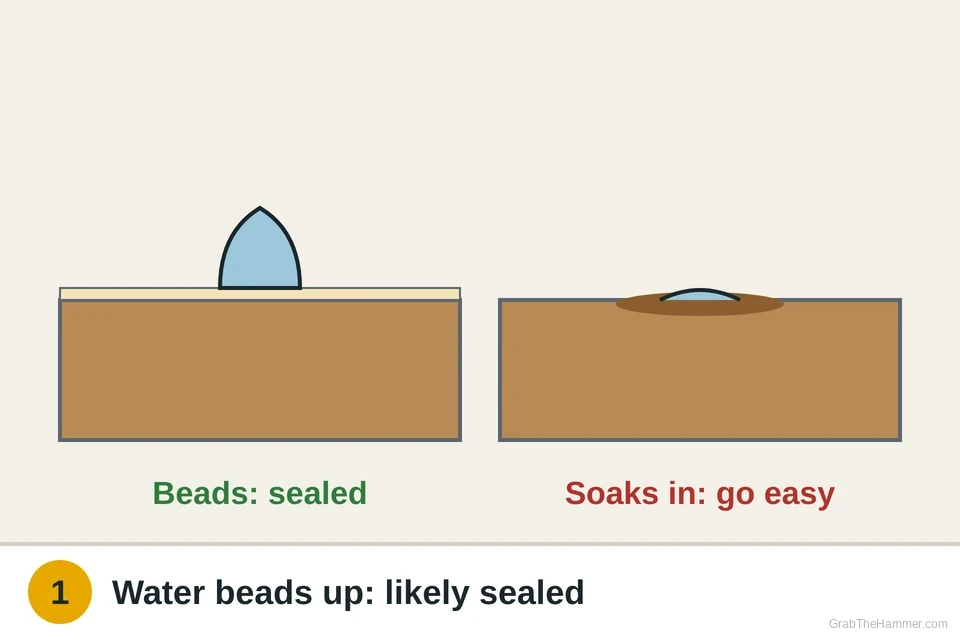
- Identify the floor and its finishKnowing the floor tells you what's safe. Laminate and luxury vinyl plank often have a printed wood look that repeats every few boards, and they click together. Real hardwood has grain that never repeats. Tile is hard and cold, with grout lines. For wood, find out if it's sealed or oiled. Put one drop of water in a hidden spot. If it beads up, the floor likely has a film finish like polyurethane. If it soaks in and darkens the wood within a few minutes, the floor may be oiled, waxed or worn. On oiled, waxed or worn floors, skip alcohol and go easy on liquids. If the floor has the maker's name on a leftover box, check their care page.
- Peel the tape slowly at a low angleIf tape is still on the floor, don't yank it straight up. Fold the loose end back over itself so you're pulling almost flat, close to the floor. Pull slowly, a little at a time, toward the part that's still stuck. This keeps more of the glue on the tape backing. If it starts to tear or leave glue, stop and go to Step 3 to warm it. For double-sided rug tape, lift the rug off first, then work on the tape left behind. Don't pry under the tape with a metal knife; it can gouge the finish and chip laminate edges. A fingernail or plastic card is enough to start a corner.

- Warm the glue and lift it with plasticSet a hair dryer to low or medium heat and hold it about 6 inches above the residue. Move it back and forth for about 30 seconds, until the glue feels soft and warm, not hot. Then push the glue up with a plastic scraper, a plastic putty knife or an old gift card, held nearly flat. Wipe the scraper often. You can also roll the soft glue with your thumb into a ball that picks up more glue. Don't use a heat gun on high; too much heat can damage the finish or warp vinyl. On laminate and vinyl, keep the dryer moving so one spot never gets hot to the touch.

- Wash with warm water and dish soapMix a few drops of mild dish soap into a cup of warm water. Dip a soft cloth or microfiber pad, then wring it until it's only damp, not dripping. Rub the sticky area in small circles for a minute or so, then wipe with a second cloth dampened with plain water. Dry the spot right away with a towel. This often removes a thin tacky film by itself. On laminate, keep water off the seams and never let it puddle; water in the joints can swell the core. On oiled or waxed wood, use as little water as possible. Run your fingertip over the spot once it's dry: smooth means you're done.

- Use a little oil or a tested citrus removerFor stubborn spots, oil helps break down tape glue. Put a few drops of cooking oil or mineral oil on a cloth and rub it into the residue. Let it sit about 5 minutes, then scrape gently with the plastic card. A citrus-based adhesive remover works the same way but stronger. Test it first in a hidden spot and follow the label, since some say not for vinyl or laminate. Afterward, wash the oil off with warm soapy water and dry it, or the spot stays slick. On tile, keep oil off the grout, which can soak it up and darken. If the finish turns cloudy or soft at any point, stop.

- Try rubbing alcohol, then clean the floorIf a tacky film remains on a sealed floor, vinyl or tile, try isopropyl rubbing alcohol. Dampen a corner of a cloth, test it in a hidden spot, and wait a few minutes to check for dulling. Then dab and wipe the residue, using as little as you can. Alcohol can dull some finishes, so skip it on oiled, waxed or worn wood. Open a window, since it's flammable. Never switch to acetone, nail polish remover or steel wool on laminate, vinyl or finished wood. Finish by cleaning the area with the floor cleaner made for that floor. If residue still won't budge, stop; a flooring pro can assess it.

Watch it done
- Your fingertip glides over the spot with no tack
- No dust or hair sticks to it after a day
- The finish looks the same as the floor around it
- No oily dark patch or haze remains
Still tacky, or the finish changed? Stop and see the steps below or call a flooring pro.
If it comes back
If the spot turns dull or hazy after cleaning, the residue is gone but the finish sheen changed. See the guide for a dull hardwood floor for how to bring it back.
If scraping left fine marks, they're usually only in the finish. See the guide to fixing hardwood floor scratches, or the laminate scratch guide for laminate.
If a white or chalky film shows up near doors in winter, that's often salt, not glue. See the guide to removing salt stains from floors.
What a pro typically charges (a rough estimate; prices vary by area): A flooring pro typically charges roughly $150–$400 for cleanup and a finish touch-up on a small area. Asbestos testing, if needed, is a separate cost.
Find a flooring pro near you